
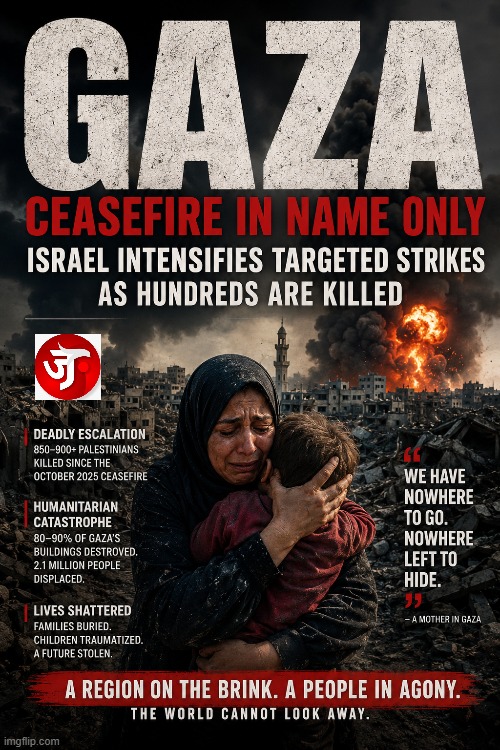
Hundreds Reported Killed – The fragile ceasefire that once promised a pause in one of the most devastating conflicts of the modern Middle East now appears dangerously close to collapse. As of May 29, 2026, Israeli military operations in Gaza have sharply intensified, with targeted strikes killing senior Hamas figures while leaving a mounting civilian toll in their wake.
What was meant to be a temporary path toward stability after the horrors unleashed on October 7, 2023, has instead become a tense and violent limbo, neither full-scale war nor genuine peace. The ceasefire brokered by the United States in October 2025 was supposed to halt the bloodshed after two years of catastrophic fighting. Yet repeated violations, retaliatory operations, and deep mistrust on both sides have steadily eroded its foundations.
In recent days, Israel has escalated a campaign of targeted assassinations aimed at dismantling Hamas’s military leadership. On May 26, a major Israeli airstrike struck the al-Rimal neighborhood of Gaza City, reportedly killing Mohammed Odeh, the newly appointed head of Hamas’s military wing, along with members of his family. The strike came shortly after the reported killing of his predecessor, Izz al-Din al-Haddad, signaling a relentless effort by Israel to decapitate Hamas leadership structures.
The Israeli government and the Israel Defense Forces (IDF) maintain that these operations are necessary acts of self-defense, designed to prevent Hamas from regrouping, rearming, and preparing future attacks. Israeli officials argue that Hamas continues to exploit ceasefire conditions to rebuild military capabilities, leaving Israel with what it describes as no choice but to act preemptively.
But in Gaza, the reality unfolding on the ground is one of continuing devastation.
Health authorities in the enclave report that between 850 and 900 Palestinians have been killed since the ceasefire formally began in October 2025. Many of the dead are civilians – women, children, and families caught in strikes targeting densely populated urban neighborhoods. Entire residential blocks continue to vanish under bombardment, adding to destruction already described by humanitarian organizations as unprecedented in modern Palestinian history.
More than 19 months after the ceasefire took effect, Gaza remains trapped in a humanitarian catastrophe of staggering proportions.
Across the territory, an estimated 80 to 90 percent of buildings have been damaged or destroyed. In many neighborhoods, over 90 percent of homes are no longer habitable. Northern Gaza, Gaza City, Khan Younis, and Rafah resemble landscapes of ruin, where collapsed concrete, shattered roads, and twisted steel stretch for miles.
The destruction of civilian infrastructure has crippled nearly every aspect of life. Water and sanitation systems have largely collapsed. Sewage flows openly through streets in some areas. Access to clean drinking water remains dangerously limited, forcing many families to survive on a few liters per person each day. Hospitals function under extreme pressure, battling shortages of electricity, medicine, fuel, and medical supplies while struggling to treat thousands of wounded civilians.
Humanitarian agencies estimate that over 72,000 Palestinians have been killed since October 2023, while more than 170,000 have been injured, including tens of thousands left with life-altering disabilities. Children continue to bear the heaviest burden, many orphaned, displaced, malnourished, or psychologically scarred after nearly three years of continuous trauma.
Nearly the entire population of Gaza, approximately 2.1 million people, has been displaced, many multiple times. Hundreds of thousands remain crammed into overcrowded tents, damaged schools, or makeshift shelters vulnerable to flooding, disease, and extreme weather.
Reconstruction efforts have barely begun. Restrictions on fuel, generators, construction materials, and spare parts, combined with political deadlock and severe funding shortages, have slowed recovery to a crawl. International aid agencies warn that only a fraction of the required humanitarian funding has been delivered, leaving millions dependent on shrinking aid supplies.
Meanwhile, fear dominates daily life.
Even during the ceasefire, recurrent airstrikes, shelling near populated areas, drone surveillance, and movement restrictions have created an atmosphere of permanent insecurity. Parents fear sending children outdoors. Families sleep uncertain whether the next strike will arrive before dawn.
The international community has repeatedly called for restraint and de-escalation, but diplomatic momentum remains weak. Negotiations aimed at securing a permanent peace agreement have stalled amid ongoing violence and political paralysis. Mutual accusations continue to poison efforts toward compromise, while extremist rhetoric on all sides deepens divisions.
For many observers, the tragedy of Gaza now reflects not only a military conflict but also the collapse of political imagination. Decades of failed diplomacy, cycles of revenge, blockade, militant attacks, occupation, and regional polarization have created a reality where civilians continue to pay the highest price.
And yet, amid the destruction, the human need for dignity, safety, and peace remains unchanged.
The people of Gaza and Israel alike continue to live under the shadow of fear, grief, and uncertainty. Without meaningful international intervention, sustained humanitarian access, accountability for violations, and a genuine political commitment to peace from all parties involved, the region risks sliding back into an even deadlier phase of conflict.
The warnings are no longer abstract. Entire generations are growing up surrounded by rubble, trauma, and hatred.
If this fragile ceasefire collapses completely, the consequences may extend far beyond Gaza’s borders reshaping regional stability for years to come