
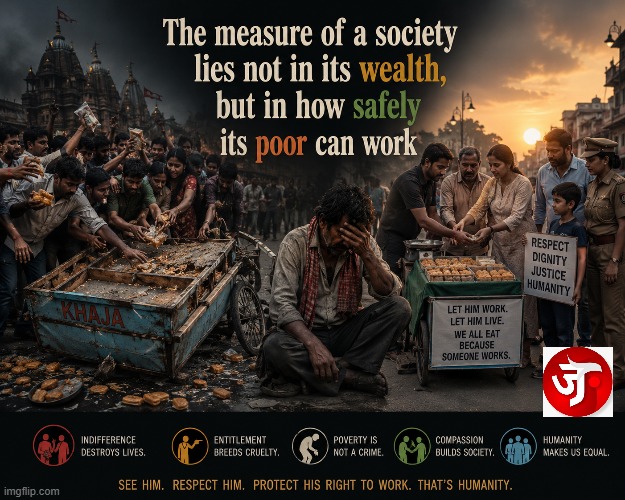
A viral video from Puri, Odisha, recent, raw, and disturbingly familiar in its cruelty, has ignited outrage across the internet.
On the evening of May 28, amid the rush of devotees along Bada Danda, the grand road leading to the Jagannath Temple, traffic and enforcement officials detained a poor street vendor for the “crime” of selling khaja – the crisp, flaky sweet deeply tied to the city’s culture and pilgrimage.
The visuals are painful not because they are extraordinary, but because they are heartbreakingly ordinary: a struggling man trying to earn a few rupees, confronted by authority in full public view, while crowds watched in silence. In a city built on faith, devotion, and compassion, the incident has raised unsettling questions about dignity, livelihood, and the unequal weight of the law.They took him away, leaving his cart uncovered behind a fence. A crowd, many ordinary passersby and apparent devotees, then swarmed in, grabbing fistfuls of the sweets, even scooping pieces off the ground. The vendor’s entire stock for the day vanished in minutes. The erasure of his livelihood has its own kind of brutality.
These are not isolated; they form a grim pattern of enforcement meets opportunism, or outright vigilante hostility, against the most precarious:
Muzaffarnagar, Uttar Pradesh, two travelling garment sellers, Aamir Malik and his nephew Javed, reportedly went to a residential colony after being invited to sell clothes. Residents allegedly began questioning their religious identity. The two men sustained injuries and the incident sparked outrage over growing hostility toward informal workers from minority communities.
Kuldeep Singh, an ex-serviceman who sold vegetables for a living, and his teenage son were allegedly beaten during a municipal anti-encroachment operation in Machhiwara. Singh claimed officials seized his goods, assaulted him and his son, and humiliated him publicly. The incident caused widespread outrage; several civic employees were suspended and arrests followed.
Following political and administrative actions in parts of West Bengal, hundreds of hawkers reportedly faced demolition drives and evictions. Many vendors complained that stalls built over years were removed with little rehabilitation or alternative arrangements. The controversy became so significant that political leaders publicly condemned the displacement of street vendors and warned of devastating consequences for poor families dependent on hawking.
A February 2026 report documented how Kashmiri shawl vendors in several north Indian cities were facing harassment and violence. One vendor, Bilal Ahmad, was reportedly attacked in Uttarakhand after refusing to chant a nationalist slogan demanded by a group. Many traders said they were being forced to choose between personal safety and earning a livelihood away from home.
Muslim food vendors selling chicken patties near a large religious gathering at Brigade Parade Ground alleged they were attacked after being identified by name and religion. Some reported their food was thrown away, they were humiliated publicly, and years of work building their customer base suddenly felt unsafe. Police later made arrests in the case.
In Lucknow, Uttar Pradesh, Lalaram, a lai-chana street vendor who reportedly slept beside his cart, was brutally killed following a dispute involving roughly ₹10,000. Police said he was attacked while asleep and suffered fatal head injuries. The case highlighted the extreme vulnerability of poor vendors who often live and work in public spaces without protection.
In Ludhiana, Punjab, a sixty-four-year-old newspaper hawker Chaman Lal was attacked while collecting newspapers before dawn. According to reports, assailants threatened him with a knife and stole ₹13,000. Particularly troubling was his statement that people nearby did not come to help despite hearing his cries.
Although the circumstances differ, these incidents reveal a common thread: Vendors being targeted because they are poor, or because of their religion or identity; poor workers facing violence while performing everyday economic activity; hawkers losing years of investment through demolitions and evictions; street traders being treated as disposable despite serving local communities. Public indifference often compounding the harm.
We build temples and talk of dharma, yet loot sweets at its doorstep. We demand smooth roads and clean water, yet offer no dignified vending zones or empathy when the cart falls. The moral degradation the poster mourns isn’t abstract, it is us, choosing convenience, tribal suspicion, or indifference over the simple recognition that this man’s empty hands tonight mirror what any of us could become if luck turned the other way.
You cannot worship God while crushing the vulnerable under your feet. Street vendors are the invisible backbone of society, feeding cities, serving millions, and surviving with dignity against impossible odds. A nation stands not only on skyscrapers and corporations, but on the tired shoulders of street vendors who wake before dawn to keep life moving. The hands that build our streets and feed our cities deserve dignity and not humiliation. The measure of a society lies not in its wealth, but in how safely its poor can work, without treating them like cockroaches.