
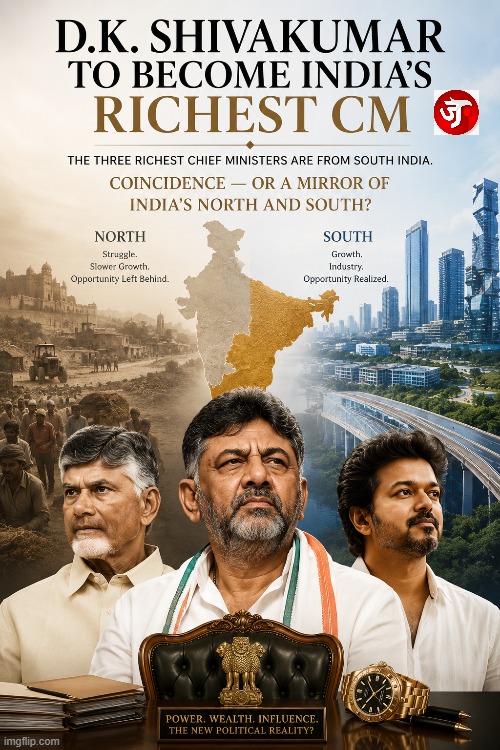
When D.K. Shivakumar takes oath as Karnataka’s Chief Minister on June 3, 2026, he will not only assume power in one of India’s most economically dynamic states, but he will also become the richest Chief Minister in the country.
According to his self-declared election affidavit from the 2023 Karnataka Assembly elections, Shivakumar possesses assets worth more than ₹1,413 crore. His portfolio includes investments, land holdings, luxury watches such as Rolex and Hublot, gold and silver assets, and major business interests in real estate and infrastructure. His wealth has risen dramatically from roughly ₹840 crore in 2018, mirroring the explosive growth of Bengaluru itself.
But perhaps the more striking fact is this: The three richest Chief Ministers in India are all from South India.
After Shivakumar comes Andhra Pradesh Chief Minister N. Chandrababu Naidu, with declared assets of approximately ₹931–936 crore, much of it linked to shares in Heritage Foods Ltd., the business empire associated with his family. Third is Tamil Nadu Chief Minister and actor-turned-politician C. Joseph Vijay, whose declared wealth of ₹624–648 crore stems from decades in Tamil cinema, investments, real estate, fixed deposits, and other holdings.
This is not a coincidence. It reflects a deeper truth about modern India: the South has increasingly become the country’s economic engine, while much of the North continues to struggle with slower development, weaker infrastructure, lower human development indicators, and overdependence on agrarian politics.
Southern India today represents a different model of governance and economic evolution:
Karnataka transformed itself into India’s Silicon Valley through Bengaluru’s IT revolution. Tamil Nadu became an industrial manufacturing powerhouse with automobiles, electronics, ports, and cinema. Andhra Pradesh and Telangana aggressively embraced technology, urban infrastructure, and global investment.
As cities like Bengaluru, Chennai, Hyderabad, and Visakhapatnam expanded, land values exploded. Those with early access to political influence, business networks, or inherited holdings saw their fortunes multiply enormously.
D.K. Shivakumar’s rise reflects precisely this transformation. His business interests in infrastructure, real estate, educational institutions, and allied sectors expanded alongside Bengaluru’s growth into a trillion-rupee metropolitan economy.
Similarly, Chandrababu Naidu’s wealth reflects not merely politics but the intersection of politics and corporate capitalism in a reform-oriented southern state. Vijay’s fortune, meanwhile, emerged from the immense economic ecosystem of Tamil cinema -one of the largest entertainment industries in Asia.
These are not isolated stories of individual wealth rather mirrors reflecting where economic energy in India has shifted.
For decades, the South invested heavily in literacy, healthcare, education, and urbanization.
While Kerala focused on human development, Tamil Nadu invested in industrialization and welfare, Karnataka cultivated technology and higher education, Andhra and Telangana aggressively pushed infrastructure and entrepreneurship.
As a result, southern states today dominate many indicators: Higher per capita income, better literacy rates, lower fertility rates, better healthcare outcomes, higher urbanization, greater female workforce participation, stronger private-sector ecosystems.
Meanwhile, many northern states remain trapped in cycles of population pressure, poor education systems, caste-centered electoral politics, unemployment, and weaker governance structures.
This does not mean the North lacks wealth or talent. Delhi, Haryana, Punjab, and parts of western Uttar Pradesh remain prosperous. But on average, the developmental gap remains significant.
The South contributes disproportionately to India’s GDP relative to its population size. It produces more taxes, more exports, more IT services, more manufacturing output, and increasingly more political influence.
But is the South truly “superior”? That is where the conversation becomes dangerous. The South’s economic lead is real. But “superiority” is an oversimplification. Not every southern state is wealthy, and not every northern state is poor, not every southern politician is rich, and not all wealth in politics is clean.
The asset declarations of politicians are self-reported affidavits and not forensic audits. Allegations of corruption, land accumulation, and opaque political-business relationships exist across India, regardless of region.
Of course, wealth alone is not a measure of governance.
Kerala’s relatively modest political class coexists with strong human development while Karnataka’s immense wealth exists alongside corruption scandals and infrastructure strain., and Tamil Nadu’s prosperity coexists with political dynasties and intense welfare dependency.
Similarly, the North is evolving too. Cities like Noida, Gurugram, Lucknow, and Indore are emerging rapidly. Uttar Pradesh is investing heavily in expressways and industrial corridors. Bihar’s growth rates have improved from historical lows.
It is important to mark that India’s future will not be determined by North versus South, but rather on whether the rest of India can replicate the South’s investments in education, human capital, infrastructure, and governance.
The real story is India’s uneven development and the rise of the three richest Chief Ministers from South India is not merely gossip about political wealth. The real political story behind the staggering wealth of India’s southern Chief Ministers is not simply that they are rich, but that they emerged from the parts of India that transformed themselves fastest in the post-liberalization era.