
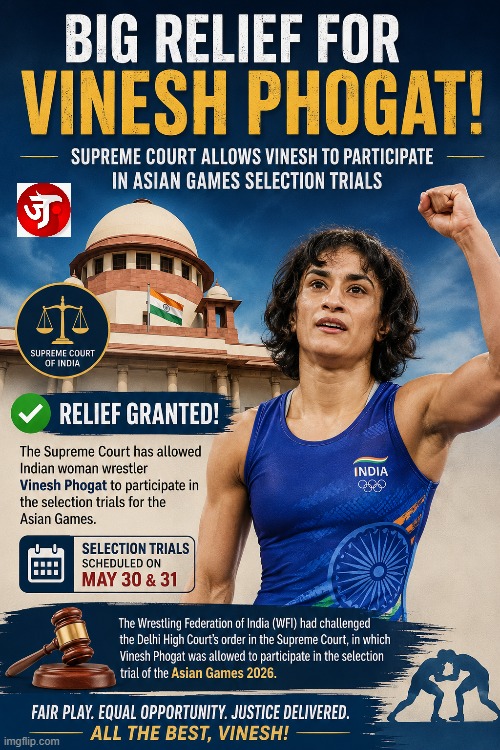
In a significant boost to her comeback journey, three-time Olympian Vinesh Phogat has secured a major legal victory. The Supreme Court of India on Friday (May 29, 2026) allowed her to participate in the Wrestling Federation of India’s (WFI) selection trials for the 2026 Asian Games, scheduled for May 30 and 31 in New Delhi.
The apex court refused to stay the Delhi High Court’s earlier order, enabling the veteran wrestler to step onto the mat despite ongoing disputes with the federation.
Background of the Dispute: Vinesh Phogat, a trailblazer in Indian women’s wrestling with medals at the Asian Games, Commonwealth Games, and multiple World Championships, has faced multiple hurdles since announcing her return to competition after maternity leave and the Paris 2024 Olympics (where she was disqualified in the final for being overweight).The WFI’s selection criteria for the 2026 Asian Games required wrestlers to have won medals in specific recent domestic events (2025 Senior Nationals, 2026 Federation Cup, etc.). Since Vinesh had not competed in these due to her break, she was declared ineligible. The federation also issued a show-cause notice citing alleged anti-doping whereabouts failures and past issues.
Vinesh approached the Delhi High Court, challenging the exclusionary policy. On May 22, a division bench ruled in her favour, observing that:
- Motherhood and maternity-related breaks cannot be treated as a “disability” or ground for exclusion.
- The WFI’s policy appeared “clearly exclusionary” and lacked discretion for exceptional athletes.
- The trials must be video-recorded with independent observers from the Sports Authority of India (SAI) and Indian Olympic Association (IOA) present.
The WFI swiftly moved the Supreme Court, terming the High Court order “ex facie illegal” and arguing it undermined the federation’s selection framework and international deadlines. A bench comprising Justices P.S. Narasimha and Alok Aradhe heard the matter urgently on May 29.
While granting relief to Vinesh, the Supreme Court expressed reservations about frequent judicial intervention in sports administration. Justice Narasimha reportedly remarked that sports disputes cannot be treated like medical admissions and reminded that “country first,” while acknowledging Vinesh’s stellar achievements. The court posted the matter for further hearing on June 1.
What This Means for Vinesh Phogat
This ruling allows Vinesh to compete in the women’s wrestling trials on May 30 at Indira Gandhi Stadium, New Delhi. A strong performance could pave the way for her selection to represent India at the 2026 Asian Games in Aichi-Nagoya, Japan (September 30–October 3, 2026).
Vinesh’s supporters view this as a victory for fairness and gender sensitivity in sports, especially for athletes balancing motherhood and elite careers. Critics, including the WFI, argue it sets a precedent that could disrupt standardized selection processes.
This episode is part of a larger tussle between Indian wrestlers and the federation, echoing previous protests and court interventions involving Vinesh, Bajrang Punia, and others. It highlights ongoing debates around eligibility rules, athlete welfare, maternity protections, and governance in Indian wrestling. As the trials approach, all eyes will be on Vinesh Phogat’s performance. At 31, she remains one of India’s most determined and decorated wrestlers, proving once again that her fight extends far beyond the mat.
Stay tuned for live updates from the selection trials on May 30–31.