
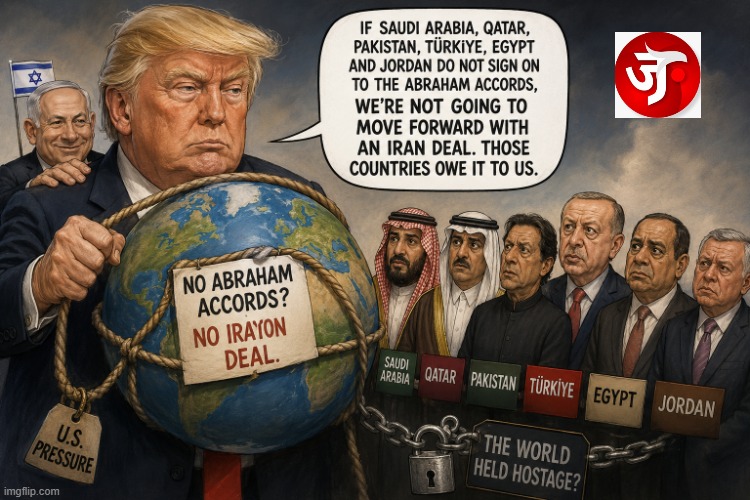
On May 25, 2026, in a provocative statement, Donald Trump made a series of posts on his Truth Social platform, he asserted that as part of any agreement to end the war with Iran, it should be “mandatory” for Saudi Arabia, Qatar, Pakistan, Tukiye, Egypt, and Jordan to simultaneously sign onto the Abraham Accords. This position raises a critical question: Is Trump leveraging U.S. authority to advance Israeli interests at the expense of broader regional stability?
Critics of Trump’s approach argue that tying an Iran agreement, which deals with vital issues of nuclear proliferation, regional security, and the specter of war, to the normalization of relations with Israel amounts to a coercive strategy. By insufficiently addressing the Palestinian issue, many believe he is holding the region hostage, using the demand for acceptance of Israeli integration as a bargaining chip. This tactic not only pressures key Middle Eastern nations but also sidesteps the complex realities of longstanding conflicts.
Most of the countries Trump named (Saudi Arabia, Qatar, Pakistan, Turkiye, Egypt, Jordan) are not currently willing to sign onto the Abraham Accords expansion in May 2026. Saudi clearly stated in May 2026 they are not willing to sign it without a clear, irreversible pathway to a Palestinian state. MBS has cooled on full normalization despite past interest. Saudi officials emphasize diplomacy over Trump’s linkage to the Iran deal
What is the Abraham Accords: The Abraham Accords (2020) is a series of U.S.-brokered peace agreements that normalized diplomatic and economic relations between Israel and several Arab countries for the first time in decades, agreeing to full diplomatic relations, Economic cooperation, security and intelligence sharing; and cultural and people-to-people ties. This pragmatic “peace for peace” deal was based on mutual interests rather than solving the Palestinian conflict first. Trump is now pushing to expand it to more countries (Saudi Arabia, etc.) in 2026.
Supporters, on the other hand, contend that Trump seeks to forge a new regional security architecture. They argue that integrating Israel with major Muslim-majority countries could diminish hostilities, curb Iran’s influence, and unlock potential economic partnerships. The vision is to create an atmosphere where shared interests take precedence, potentially diminishing future conflicts.
Yet, despite this optimistic outlook, skepticism looms large among many governments regarding aligning with the Abraham Accords given the ongoing Gaza war and the unresolved Palestinian plight. The pressure to normalize relations with Israel in the absence of tangible progress on these sensitive issues raises alarms not just among critics but among those who perceive it as a blatant disregard for Palestinian rights.
The significance of the Abraham Accords themselves cannot be understated. They marked a dramatic shift in Arab-Israeli relations, breaking a long-standing taboo that conditioned normalization on resolving the Israeli-Palestinian conflict. By allowing for normalization based on shared interests, security, economics, and technology, they created an informal anti-Iran coalition, enhancing defense and intelligence cooperation among Israel and Gulf states.
However, the Accords also sparked resentment. Palestinian leaders have termed them a “stab in the back,” feeling betrayed as normalization occurred without meaningful concessions from Israel regarding occupation and settlements. This sentiment resonates with a substantial portion of Arab public opinion, which remains largely opposed to the Accords. Surveys indicate widespread disapproval throughout the Arab world, with only a minuscule fraction supporting recognition of Israel-87% oppose it.
This divide poses a challenge not just for Trump’s diplomatic aspirations but for the future of peace in the region. For many in the Arab world, solidarity with Palestinians remains a matter of justice, transcending political motives and demanding genuine resolutions. The Accords, heralded by some as a breakthrough, are perceived by others as embedding inequities, reinforcing the belief that U.S. influence prioritizes Israeli interests over Arab sovereignty and rights.
As the geopolitical landscape continues to evolve, the pivotal question emerges: Are the Abraham Accords a pathway to peace or a mechanism that holds the Middle East hostage to the whims of U.S.-Israeli strategy? Only time will tell if Trump’s gamble yields a more stable and prosperous future for all involved or deepens existing fractures within the region, which is in turn, is affecting the world due to the choking oil supply to the world.