
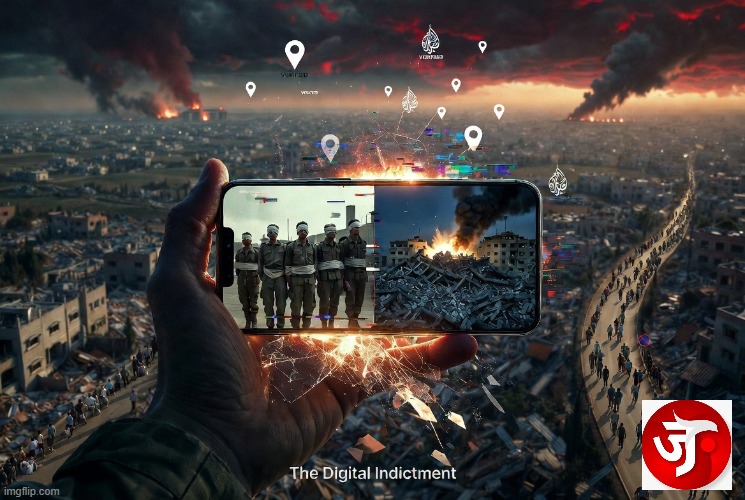
In every war, truth is often veiled long after the smoke clears. Yet in Gaza, amid the collapse of neighborhoods, hospitals, and entire family lines, another phenomenon has emerged alongside the devastation: a digital archive so vast, visual, and instant that it has become increasingly difficult to dismiss. What was once hidden in the fog of battle now streams across social media in high definition.
It has become politically sensitive to speak openly about Israeli military actions in Gaza. Reports emerging from Palestinian journalists, aid workers, or independent investigators are frequently dismissed as biased or fabricated before their evidence is even examined. In the age of algorithmic warfare, competing narratives travel at the speed of outrage. But modern conflict now carries an involuntary chronicler – the smartphone camera. Soldiers themselves, knowingly or unknowingly, have become documentarians of the battlefield.
The result is a growing forensic archive built not merely on accusation, but on satellite imagery, geolocation, intercepted audio, social-media footage, witness testimony, and battlefield reconstruction. Organizations such as Bellingcat, Reuters, Human Rights Watch, Forensic Architecture, Al Jazeera’s Investigative Unit, and UN commissions have pieced together an increasingly disturbing pattern of conduct during Israel’s military campaign in Gaza. Israel rejects many of the gravest allegations, insists it is targeting Hamas militants embedded among civilians, and says individual incidents are investigated. Yet the sheer volume of visual evidence has made the conflict impossible to reduce to simple propaganda.
A major international controversy erupted after New York Times columnist Nicholas Kristof published a report citing testimonies from former Palestinian detainees, lawyers, doctors, and human-rights investigators alleging severe abuse inside Israeli detention facilities following the Gaza war. The allegations included sexual violence, forced nudity, beatings, torture, dog attacks, humiliation, and degrading treatment of detainees, with some accounts describing abuse at facilities such as Sde Teiman. Kristof’s reporting drew heavily on interviews, medical evidence, and findings already raised by UN experts and rights organizations, which had separately documented what they described as credible allegations of systematic mistreatment of Palestinian prisoners, including women, men, and minors.
Several UN-linked reports stated they had received substantiated testimonies involving sexual assault, threats of rape, electrocution, forced stripping, and severe physical abuse in custody. The publication of the article triggered fierce backlash from Israeli officials, with Prime Minister Benjamin Netanyahu and other leaders strongly denying the allegations, accusing the newspaper of defamation and bias, and threatening legal action against both the New York Times and Kristof himself. The New York Times defended the article, saying it underwent extensive fact-checking and was based on corroborated testimony and documented human-rights findings. While many of the allegations have not yet been tested in criminal courts, the growing body of reports from UN investigators, Human Rights Watch, medical personnel, and visual evidence from detention sites has intensified international scrutiny over Israel’s treatment of Palestinian detainees during the conflict.
The significance of these videos lies not only in what they depict, but in who filmed them. In earlier wars, atrocities often relied on survivor testimony alone. In Gaza, soldiers have at times provided the evidence themselves.
Few incidents illustrate this more powerfully such as the killing of six-year-old Hind Rajab: On January 29, 2024, Hind became trapped inside a bullet-riddled car in Gaza City after her family vehicle came under intense gunfire while fleeing Israeli military operations in Tel al-Hawa. What transformed her death into one of the defining civilian tragedies of the war was not merely the horror itself, but the fact that the world heard it unfold in real time.
Subsequent investigations by The Washington Post and Forensic Architecture used satellite imagery, geolocation analysis, audio timelines, battlefield mapping, and forensic reconstruction to challenge initial Israeli denials that troops were nearby. Forensic Architecture estimated that approximately 335 rounds struck the civilian car. The findings intensified international outrage, with the United States calling Hind’s death “an unspeakable tragedy” while human rights experts raised possible war-crime allegations. Hind Rajab’s killing is not an isolated symbol. It sits within a wider body of documented evidence emerging from Gaza.
Other footage collected by Bellingcat and Al Jazeera’s Investigative Unit documented the demolition of homes, apartment blocks, and civilian infrastructure across Gaza. Videos show explosions ripping through residential neighborhoods while soldiers cheer, celebrate, or pose for social-media clips beside the destruction. Open-source investigators have catalogued these recordings into a searchable archive of self-documented warfare.
Human Rights Watch later concluded that Israel’s evacuation policies and military operations had resulted in the mass forced displacement of Gaza’s civilian population. More than 90 percent of residents, roughly 1.9 million people, were displaced, many repeatedly. Routes and zones civilians had been instructed to flee toward were later struck. Forensic Architecture mapped patterns showing civilians herded into shrinking pockets of territory that themselves came under bombardment.
The humanitarian consequences became catastrophic: overcrowded shelters, collapsing sanitation systems, shortages of food and medicine, and growing disease outbreaks. Human Rights Watch accused Israel of intentionally restricting water, fuel, aid, and essential supplies in ways that could amount to crimes against humanity. Israel rejects these allegations and argues Hamas’s military infrastructure complicates humanitarian operations.
Meanwhile, Reuters’ visual investigation into the August 2025 strike on Nasser Hospital further intensified scrutiny. Using video analysis and witness testimony, Reuters reconstructed evidence suggesting multiple strikes killed journalists and rescuers who had gathered after an initial blast. Israel said the incident was a tragic mistake under investigation.
Committee to Protect Journalists (CPJ) documented at least 232 journalists and media workers killed by August 2025, including 184 Palestinians and writes: “Israel has now killed more journalists than any other government since CPJ began collecting data in 1992, making this war the deadliest on record for journalists.”
The cumulative effect of these investigations is profound. No single video proves genocide, and no single incident defines an entire military campaign. War is chaotic, and armed groups do operate among civilian populations. Israel continues to argue that Hamas’s tactics place civilians at risk and that its broader campaign constitutes lawful self-defense after the October 7 attacks.
But the central issue raised by Gaza’s digital archive is not one isolated mistake. It is the emerging pattern.
In Gaza, despite trying to obliterate journalists, as it seems, the evidence of atrocities in the war did not disappear into silence. It entered the archive. And that archive continues to stare back at the world with an unblinking eye.