
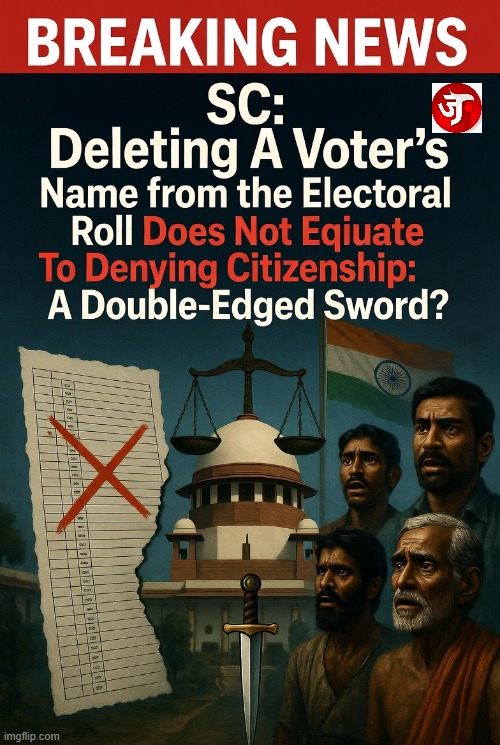
In a landmark judgment, the Supreme Court of India, led by Chief Justice Surya Kant and Justice Joymalya Bagchi, has upheld the Election Commission of India’s (ECI) authority to carry out Special Intensive Revision (SIR) of electoral rolls. At first glance, this verdict appears to bolster the integrity of India’s electoral framework by endorsing the ECI’s mandate to ensure accurate and updated voter lists. However, a deeper examination reveals significant implications that could impact voter inclusion and democracy itself.
The crux of the Supreme Court’s ruling is the assertion that deleting a voter’s name from the electoral roll does not equate to denying citizenship. Instead, it signifies that an individual has failed to meet the necessary electoral requirements during the revision process, which include proof of ordinary residence and compliance with the Representation of the People Act, 1950. The Court outlined that this exercise aligns with Article 324 of the Constitution, which grants the ECI the power to supervise, direct, and control the conduct of elections. This focus on maintaining clean electoral rolls is indeed necessary, especially in light of bloated voter lists that have accumulated over two decades without comprehensive revisions.
From a legal perspective, the judgment introduced several strengths that advocate for the ECI’s position. First and foremost is the necessity of electoral integrity. With states like Bihar witnessing the removal of approximately 4.7 million names, mostly from non-controversial categories, the judgment facilitates what can be viewed as a legitimate housekeeping function. By ensuring that electoral rolls reflect the true demographics of eligible voters, the ECI is fostering an environment conducive to free and fair elections.
Additionally, the Court rightly delineated the boundaries of electoral eligibility from the complex adjudication of citizenship, a matter that falls under the purview of Foreigners Tribunals and courts. This differentiation adds a much-needed legal clarity, reassuring the public that the removal of a name does not equate to being labeled a foreigner. Furthermore, the Court mandated measures to enhance transparency in the SIR process, like providing reasons for deletions and establishing appellate tribunals in various states.
Despite these strengths, the judgment raises pressing concerns, particularly regarding the potential disenfranchisement of legitimate voters. Critics, including notable petitioners like the Association for Democratic Reforms (ADR), have expressed that the SIR places an undue burden on citizens by reversing the presumption of eligibility. Traditionally, once a citizen is enrolled, they are presumed eligible to vote. However, the new process shifts the onus of proof onto individuals, particularly those from marginalized communities who may lack documentation. This shift could inadvertently disenfranchise genuine voters, especially those who are poor, rural, or belong to minority groups.
Moreover, the implementation of SIR, particularly in states like West Bengal where large-scale deletions have occurred, has been marred by accusations of targeted exclusions. The cumbersome nature of the appeals process, combined with potential bureaucratic overreach and political bias, raises serious questions about the efficacy and equity of the electoral revision process. The timing of these revisions, occurring just before elections, breeds suspicion and fuels fears of politically motivated motives aimed at suppressing opposition-leaning voters.
While the Court clarified that the SIR is not meant to serve as a mechanism for adjudicating citizenship, there remains a palpable risk of a chilling effect on voters. The fear of being flagged as “doubtful” could deter individuals from exercising their right to vote or accessing welfare schemes, further marginalizing already vulnerable populations.
With an estimated impact on over 500 million voters nationwide, the scale of SIR implementation necessitates careful consideration. The marginalized groups, migrants, women, the elderly, and minorities, often lack the means to fulfill the documentation requirements swiftly, raising serious constitutional concerns under Articles 14 (right to equality) and 21 (right to life and personal liberty).
In summary, the Supreme Court’s judgment in favour of electoral roll purification is legally sound and reinforces the ECI’s vital role in maintaining the democratic process. However, the optimism surrounding the judgment must be tempered with caution regarding its implementation. The real test lies not just in the Court’s ruling but in the ECI’s capacity to uphold transparency and ensure that the process of voter deletion is non-discriminatory and minimally disruptive.
Ultimately, while the judgment can be seen as a victory for electoral hygiene, it simultaneously represents a potential setback for maximum voter inclusion. The future of India’s democratic ethos will depend not only on the legality of the SIR but also on the conscientious efforts of the ECI and the government to ensure that every citizen’s right to vote remains inviolable.