
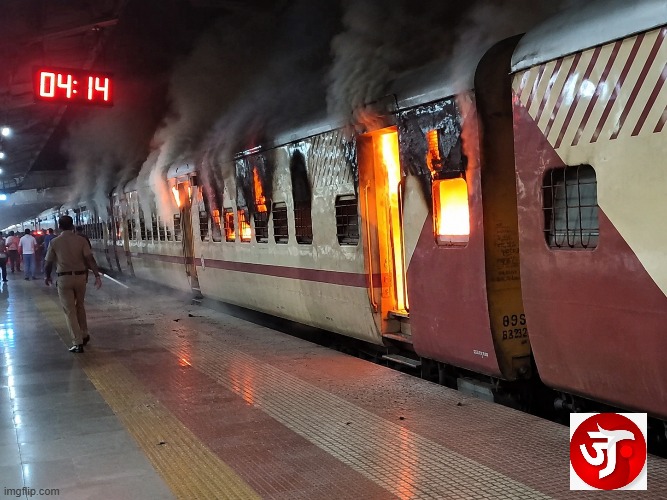
Early Monday morning, a fire broke out aboard the Sasaram–Patna passenger train at Sasaram. Panic spread quickly across the station platform as one coach was engulfed in flames. Initial reports again pointed toward a suspected short circuit.
The early Monday morning Sasaram–Patna Passenger Train Fire on May 18th early morning sent panic waves when a major blaze engulfed a coach of the Sasaram–Patna passenger train at Sasaram station. Thick smoke and flames caused panic on the platform, though no casualties were reported. Railway officials again cited a suspected short circuit as the likely cause.
The series of train fires in 2026 is alarming: Thiruvananthapuram–Hazrat Nizamuddin Rajdhani Express Fire on May 2026 was alarming. The fire broke out in an AC coach of the prestigious Rajdhani Express near Ratlam in Madhya Pradesh on May 17, 2026. Two coaches were reportedly damaged, rail traffic on the Mumbai–Delhi corridor was disrupted, and passengers were evacuated safely. Preliminary investigations pointed toward a possible electrical fault or short circuit.
Reports from Bihar identified the affected Sasaram train more specifically as the Bhabua–Patna Intercity Express. One general coach was gutted by flames while the train was stationed at Platform 6.
Then in April 2026, the Okha–Guwahati Express saw a dangerous smoke incident near Kanpur after suspected brake binding that caused smoke from a coach. Panic spread among passengers, and some jumped off the train, leading to fatalities after people were struck by another train on an adjacent track.
These incidents have reignited debate over railway safety, especially around: The recent Rajdhani incident also revealed another troubling reality: even rescue systems remain vulnerable. A repair and relief vehicle rushing toward the burning train itself overturned into a gorge, injuring railway workers. It was a symbolic image of a broader strain — a system often trying to save itself while already overstretched.
The images have begun to feel hauntingly familiar. Smoke billowing from train coaches. Passengers running along platforms clutching children and bags. Railway staff smashing windows, shouting instructions, trying to prevent panic from turning into catastrophe.
In the past two days alone, these two major train fire incidents did not seem just ordinary, rather eerie.
A large part of India’s railway fleet still operates using coaches and electrical infrastructure designed decades ago, long before today’s heavy energy demands. Modern trains now power air-conditioning units, charging ports, LED systems, pantry equipment, surveillance devices, Wi-Fi systems, and increasingly complex electronics. Many older coaches were never originally engineered to handle such continuous electrical stress. Over time, insulation weakens, cables crack, switchboards corrode, and transformers overheat — especially under India’s brutal summer temperatures, humidity, dust, and constant vibration. A small spark inside an aging electrical compartment can quickly spread through wiring channels and coach interiors, turning a technical fault into a life-threatening fire within minutes.
One of the biggest concerns experts repeatedly raise is retrofitting. Instead of completely replacing aging electrical systems, additional appliances and systems are often layered onto old infrastructure. Every extra fan, charging point, kitchen appliance, or AC load increases pressure on wiring networks that may already be operating near capacity. In sleeper and passenger coaches, illegal passenger devices — unsafe chargers, power strips, heating rods, or battery packs — can further overload circuits. In many cases, fires may not begin because of a single dramatic failure, but because systems are quietly overheating day after day until one short circuit finally ignites surrounding material.
Railways function under enormous operational pressure. Coaches are expected to remain in near-constant circulation with minimal downtime, leaving maintenance crews racing against schedules. Safety inspections that should be meticulous can become rushed. Wiring checks, thermal inspections, replacement of worn insulation, and testing of extinguishers may not always receive the attention they require. Some experts argue that India often responds strongly after accidents, but preventive maintenance remains chronically underfunded or unevenly enforced. The deeper issue is not always negligence by individual workers, but a system stretched by scale, passenger volume, staffing shortages, and pressure to keep trains moving without delay.
Train fires become terrifying because of how rapidly panic spreads. Smoke fills narrow corridors, visibility collapses, and passengers often do not know where emergency exits or extinguishers are located. In past incidents, survivors described jammed doors, broken communication systems, and confusion among staff and passengers alike. Many trains still lack advanced smoke-detection systems or automatic suppression technology commonly used in modern rail networks globally. Emergency drills are rarely visible to the public, and crowded coaches can make evacuation nearly impossible within the short window before toxic smoke overwhelms passengers. Even the recent Rajdhani incident exposed another vulnerability: a relief vehicle rushing to help reportedly overturned into a gorge, injuring railway workers themselves -a reminder that rescue infrastructure can also be overstretched.
At first glance, these may appear like isolated accidents. But together they raise a larger, uncomfortable question: why do such fires continue to happen with alarming regularity in India’s trains and public infrastructure? India’s railways are among the busiest transport networks on earth, carrying millions daily across enormous climatic extremes — scorching heat, dust, humidity, monsoon flooding, and relentless operational pressure. Coaches are expected to function continuously with minimal downtime. Safety inspections often happen under pressure to maintain schedules. Aging infrastructure is repeatedly stretched instead of comprehensively replaced.
To be fair, not every fire is caused solely by infrastructure failure. Passenger negligence also plays a role in some cases. Illegal transport of inflammable materials, cigarette smoking near coach connections, unsafe charging devices, gas cylinders, and overcrowding can worsen risks dramatically. But public negligence becomes far more dangerous when combined with aging infrastructure and weak enforcement.
The most sobering part is how normalized these near-disasters have become. A coach burns, videos trend online, everyone expresses shock, and then the country moves on — until the next fire erupts somewhere else. But every “tragedy narrowly averted” is also a warning. One delayed evacuation, one locked exit, one midnight blaze in a fully packed sleeper coach, and the outcome could be catastrophic.
India’s railway modernization has become highly visible – Vande Bharat trains, redeveloped stations, digital ticketing, AI surveillance, bullet train projects, and sleek branding campaigns symbolize a fast-changing railway network. But critics increasingly ask whether invisible safety infrastructure is receiving equal priority. A passenger sees modern station façades and high-speed trains, but does not see the condition of electrical insulation beneath panels, the age of wiring behind walls, or whether thermal sensors are functioning properly. Preventive modernization is less glamorous than ribbon-cutting ceremonies, yet it is exactly what prevents disasters. The concern is not that modernization itself is wrong, but that appearance-driven progress can sometimes overshadow the quieter, less visible investments that truly keep passengers alive.
Because in the end, passengers do not care whether a train looks modern from the outside if smoke begins rising from inside the coach.