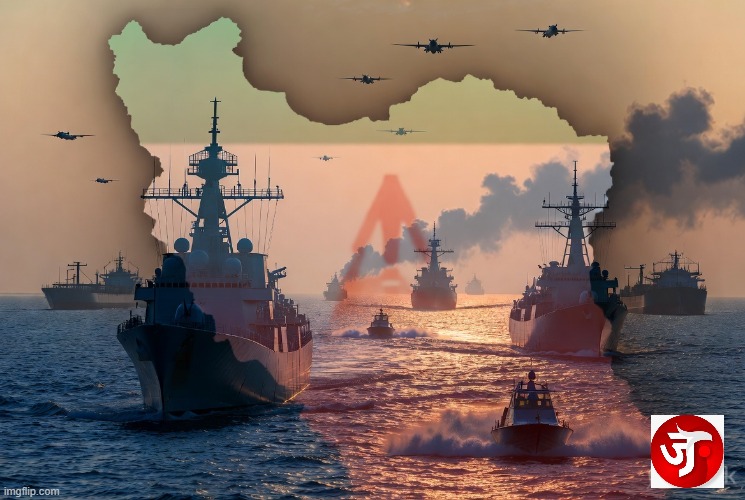
The standoff between the United States and Iran remains tense despite a pause in direct fighting, with both sides exchanging sharp warnings and keeping the door open to renewed conflict. Iran has strongly condemned the US naval blockade as an “intolerable” extension of military operations, while President Donald Trump has signalled that war could resume if diplomatic talks fail. Centred on the strategic Strait of Hormuz, with ongoing Israeli actions in Lebanon and persistent military posturing across the region, the crisis is developing into a prolonged geopolitical confrontation carrying significant global economic risks.
Iran’s President Masoud Pezeshkian has described the US naval siege of Iranian ports as an “extension of military operations,” calling it unacceptable and highlighting Tehran’s growing frustration even during the ceasefire pause. In parallel, Iranian Revolutionary Guards have warned Washington that a military option remains impossible and any imposed deal would be rejected outright.
President Trump, meanwhile, has openly indicated the possibility of restarting hostilities. “We might need” to resume the war with Iran if talks do not yield results, he stated, while noting that details of the ongoing discussions are being kept within a tight circle.
Although backchannel diplomacy continues, deep mutual distrust persists. Iran has floated the idea of easing restrictions in the Strait of Hormuz in exchange for reduced US pressure, yet Washington remains wary of Tehran’s reliability.
Strait of Hormuz: The Enduring Flashpoint
Control of the Strait of Hormuz remains the central bargaining chip. Disruptions to maritime traffic through this vital chokepoint have already affected global oil supply routes, serving as both a negotiating lever and a potential trigger for fresh escalation.
Military vigilance continues on both sides. Air defence systems around Tehran have been activated against drones and reconnaissance flights, underscoring that the ceasefire is fragile at best. In Lebanon, Israeli strikes in the south have killed more than 30 people in a single day, according to Lebanese authorities, further eroding trust in the US-backed ceasefire arrangements.
Israel has also faced international criticism after intercepting the Gaza-bound Global Sumud Flotilla in international waters, announcing it would transfer 175 detained activists to Greek authorities.
Broader Regional and Economic Impact
The crisis reflects a wider struggle involving military pressure, economic disruption, and complex diplomacy. Gulf nations and other international players are carefully balancing security needs with efforts to contain escalation. Disruptions linked to the Strait of Hormuz have driven oil prices higher, raising alarms about global economic stability and exposing the vulnerability of energy supply chains to geopolitical shocks.
With no clear breakthrough in sight and friction persisting across multiple fronts, Iran, Israel, Lebanon, and the Gulf, the situation risks settling into a long-term stalemate marked by intermittent flare-ups, sustained economic pressure, and strategic uncertainty. Both sides appear prepared for a protracted contest rather than a swift resolution.