
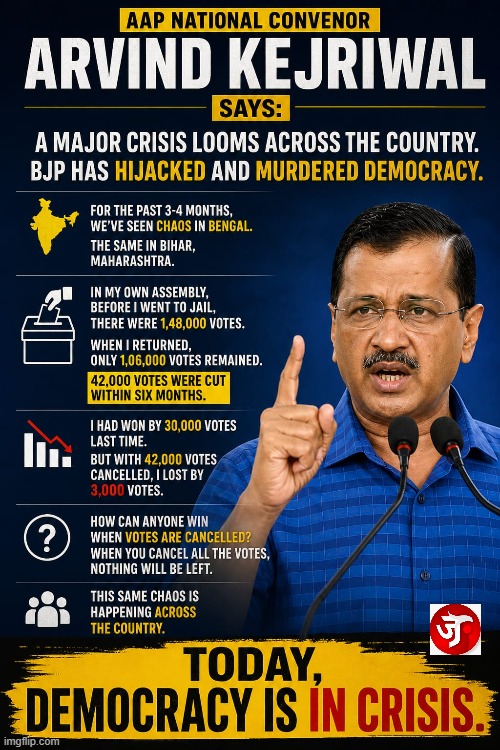
On May 5, 2026, just a day after the Election Commission declared a historic BJP victory in West Bengal, with the party securing 206–207 seats out of 294 and reducing the Trinamool Congress (TMC) to around 80, Aam Aadmi Party (AAP) national convenor Arvind Kejriwal delivered a fiery address to AAP Punjab MLAs in New Delhi. “A major crisis looms across the country today,” he declared. “The way the Bharatiya Janata Party has hijacked and murdered democracy… For the past three or four months, we’ve been watching the chaos unfold in Bengal. They did the same in Bihar, Maharashtra.”
Kejriwal zeroed in on a deeply personal grievance: his own narrow loss in the New Delhi Assembly constituency during the February 2025 Delhi polls. “In my own assembly, before I went to jail, there were 1,48,000 votes. When I returned, there were 1,06,000 votes left. They got 42,000 votes cut within six months. I won by 30,000 votes last time. 42,000 votes were cancelled. I lost by 3,000 votes.”
The numbers check out, broadly. In the 2020 Delhi elections, New Delhi had approximately 1,46,000 registered voters; by 2025, this had fallen to around 1,08,000, a net deletion of roughly 37,000–42,000 electors, or about 25% of the roll. Kejriwal polled 46,758 votes in 2020 (winning by over 21,000) but managed just 25,999 in 2025, losing to BJP’s Parvesh Verma by roughly 4,000 votes.
Kejriwal frames this not as an isolated administrative exercise but as a systematic national strategy, voter suppression through deletions during the Election Commission’s Special Intensive Revision (SIR) of electoral rolls. He alleges the same playbook was deployed in West Bengal ahead of the 2026 polls (where nearly 91 lakh names, or about 8.5–12% of the electorate, were struck off) and earlier in Bihar and Maharashtra.
The Mechanics of Voter “Cuts”: Legitimate Cleanup or Targeted Sabotage?
India’s electoral rolls are dynamic by design. The ECI routinely removes names of deceased persons, duplicates, shifted voters, and those who fail to respond to verification notices, standard housekeeping to prevent “ghost” voting. In Delhi 2025, AAP leaders like Saurabh Bharadwaj publicly flagged mass deletions in AAP strongholds, including Kejriwal’s seat, and the party even approached the ECI with complaints. The Commission responded with detailed data, asserting due process (notices issued, hearings held) and rejecting claims of foul play.8cd0fd
In West Bengal, the SIR was more contentious. Over 60 lakh deletions were justified as absentee or deceased; another 27 lakh fell into a “logical discrepancy” category unique to the state, requiring appeals that many could not resolve in time. Opposition voices, including Kejriwal (who campaigned there urging deleted voters to back TMC), argued this disproportionately affected Muslim-majority areas and was timed to tilt the scales. The Supreme Court even flagged procedural concerns during hearings. Yet BJP leaders countered that similar revisions occurred in opposition-ruled states without equivalent uproar, and the deletions exposed inflated rolls from years of lax verification.
The pattern Kejriwal highlights is real: significant roll revisions preceded BJP gains in multiple states. But causation is murkier. Delhi 2025 saw a broader anti-incumbency wave against AAP’s governance record. In Bengal, the BJP’s sweep, its first-ever majority in the state, coincided with years of accumulated grievances: the RG Kar hospital rape-murder scandal, Sandeshkhali violence allegations, syndicate raj, and TMC infighting. High voter turnout and regional shifts (including in Muslim pockets) suggest more than deletions at play.a1956c
Beyond the Rhetoric: What a “Crisis” Really Means
Losers across India’s political spectrum have cried foul over EVMs, deletions, or “institutional capture” for decades. When roles reverse, the accusations often fade. Yet the scale here invites scrutiny. Deleting millions shortly before polls, especially when margins in key seats are narrow, inevitably fuels distrust. Public faith in the ECI, once an unassailable pillar, has eroded amid polarization, with surveys showing declining confidence in electoral integrity.
Kejriwal, the former anti-corruption crusader who built AAP on promises of transparent governance, now finds himself in opposition after Delhi’s setback and national marginalisation. His warning resonates with those feeling the ground shift. But insight demands nuance: deletions require rigorous, transparent audits (perhaps with third-party verification or full VVPAT cross-checks). The ECI must proactively publish booth-level data and explain anomalies. Political parties, including the BJP in power, should welcome judicial oversight rather than dismiss critics as “sour grapes.” Trust in EVMs has been declining,” and talk of returning to paper ballots reflected growing discontentment. The deeper test of democracy is whether India’s institutions can restore confidence without partisan filters
.