
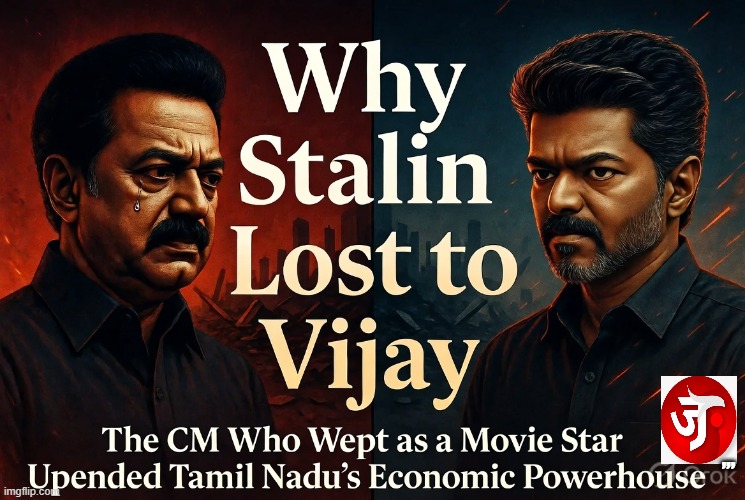
In a stunning political upset that has rewritten Tamil Nadu’s Dravidian script, M.K. Stalin – the man who steered the state toward a trillion-dollar economy – lost not just the 2026 assembly elections but his own Kolathur stronghold.
On May 4, as results poured in, the 73-year-old Chief Minister was seen emotional and teary-eyed, visibly shaken while leaving the DMK party office. He had been defeated in his home turf by V.S. Babu, a candidate from Tamilaga Vettri Kazhagam (TVK), by a margin of nearly 8,800 votes. Vijay, the 51-year-old “Thalapathy” whose two-year-old party stormed to 107-108 seats as the single-largest force, disrupting the long-standing DMK-AIADMK dominance, celebrated a historic debut victory from Perambur. DMK was reduced to around 59-60 seats, while the AIADMK trailed further behind.
The question on everyone’s minds when Thalapathy Vijay announced TVK in 2024 was simple: Could his onscreen persona as the crusader against injustice convert celluloid fandom into real political power? May 4 delivered a resounding “yes.” Joseph Vijay Chandrasekhar’s journey from 1990s romantic hero to the messianic anti-corruption warrior on screen translated into a wave that shattered the DMK-AIADMK duopoly. His electoral performance suggests that his popularity in films has translated into a strong emotional connection with voters, clearly reflected in the record 85% turnout that favoured change.
Stalin’s Undeniable Legacy: Tamil Nadu as India’s Economic Powerhouse
Yet the defeat stings precisely because Stalin’s record was formidable. Under his stewardship since 2021, Tamil Nadu has emerged as the second-largest economy in India, with an ambitious $1 trillion target by 2030 drawing global applause. His 2024 U.S. visit secured landmark FDI, including Ford’s return to the state after its earlier exit. In June 2025, he unveiled three World Bank-funded projects worth $409.79 million focused on women’s empowerment, the blue economy, and sustainable development. Chennai became home to the World Bank’s second-largest global business centre, serving 130 countries.
Beyond economics, Stalin fiercely championed Tamil heritage. He confronted the Centre over the Keezhadi excavations, accusing the BJP and RSS of trying to “erase” Tamil civilisation dating back to the 6th century BCE. Initiatives like ‘Tamizhodu Vilayadu’ and the Chennai Book Park promoted Tamil language and literature among the youth. On the federal front, he battled New Delhi over withheld education funds (₹2,150 crore in May 2025) and the three-language policy, positioning himself as a defender of state autonomy and even vowing a Supreme Court challenge alongside other non-BJP states.
His social welfare record was equally robust: the upcoming ‘Nalam Kakkum Stalin’ scheme promised free health check-ups and disability certificates via 1,256 medical camps. Massive investments in education, housing, and urban development exceeded ₹1,320 crore in projects inaugurated in May 2025 alone. Stalin’s intervention on RBI gold-loan rules reflected his sensitivity to the cultural and financial realities of ordinary Tamilians. Internationally, he condemned conflicts like Israel’s strikes on Iran and backed anti-terrorism outreach.
So, Why Did the Architect of Tamil Nadu’s Rise Fall to a Cinema Star?
Despite this impressive ledger, several factors converged to topple Stalin and the DMK:
Anti-Incumbency and the “Arrogance” Perception: After five years in power, fatigue set in. Allegations of corruption, dynastic politics (with son Udhayanidhi as Deputy CM), and a disconnect from ground realities hurt badly. A widely circulated video of Stalin allegedly shoving an elderly woman seeking help during campaigning amplified the narrative of an out-of-touch establishment. Macro successes -double-digit GSDP growth, FDI inflows, and welfare schemes failed to fully address micro-level grievances like youth unemployment, inflation, women’s safety, and the drug menace.
Vijay’s Star Power and the “Silent Wave”: TVK turned Vijay’s massive fan base, especially among youth, women, and urban voters, into a political army. His film roles as the common man fighting systemic injustice created an emotional bond that policy speeches could not match. TVK’s grassroots outreach and promise of a “fresh alternative” broke the Dravidian binary. As one TVK leader put it, “Tamil Nadu was waiting for change.” The high turnout worked in favour of the new face.
Local Infighting and Tactical Missteps: In Kolathur, internal DMK rivalries and complacency played a role. Stalin, who had won the seat comfortably three times before, was stunned by the swing to a former DMK man now flying the TVK flag. Across the state, the DMK underestimated how effectively Vijay’s charisma would mobilise first-time and swing voters.
Cinema’s Enduring Grip on Tamil Politics: Tamil Nadu has a long history of film stars shaping politics (MGR, Jayalalithaa, Karunanidhi himself). Vijay proved the tradition is alive with his on-screen saviour image becoming a real-world rallying cry against “establishment” fatigue.
Later that evening, Stalin posted a gracious message on X, accepting the people’s verdict with humility and pledging that the DMK would play the role of a strong opposition. But the tears captured in viral videos told a deeper story: the pain of seeing a lifetime of service and visionary governance overshadowed by the irresistible pull of a celluloid hero.
A New Chapter for Tamil Nadu
As TVK prepares to form the government, possibly with allies such as Congress, the verdict signals more than one leader’s defeat. It marks a seismic shift: the triumph of star-driven populism over established governance credentials, at least in the eyes of voters craving change. Stalin lifted Tamil Nadu economically and culturally, but in the end, Vijay’s emotional connect and the yearning for a “new commander” proved stronger. The 2026 verdict is not just an election result, but Tamil Nadu’s latest political blockbuster, and the credits are still rolling.