
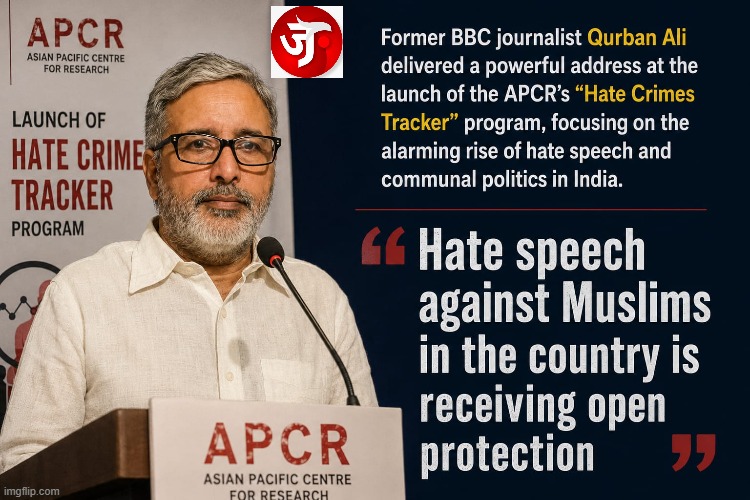
Qurban Ali Calls for Legal Action Against Hate Speech at APCR’s “Hate Crimes Tracker” Launch
Former BBC journalist Qurban Ali delivered a powerful address at the launch of the APCR’s “Hate Crimes Tracker” program, focusing on the alarming rise of hate speech and communal politics in India. His sharp comments highlighted critical concerns regarding the role of the Central Government, the judiciary, and law enforcement in addressing these issues.
During the event, Ali pointed out what he perceives as a troubling trend: “Hate speech against Muslims in the country is receiving open protection,” he stated, articulating a sentiment shared by many activists in recent years. He underscored that this environment not only threatens the safety of minority communities but also undermines the very fabric of Indian democracy.
Ali referenced recent incidents that exemplify this growing concern, including the Prime Minister’s controversial remarks labeling certain individuals as “intruders” and the inflammatory rhetoric displayed at the Haridwar Dharma Parliament. These incidents, he argued, have set a dangerous precedent for public discourse and have emboldened individuals who propagate hate.
In addition to these examples, Ali discussed the legal landscape surrounding hate speech. He noted the various Public Interest Litigations (PILs) that have been filed in the Supreme Court seeking urgent action against hate speech and the often lackluster response from the judiciary and law enforcement. “The attitude of police and courts towards hate speech cases tends to be dismissive,” he remarked, calling it a significant impediment to justice for victims.
During his address, Ali firmly asserted the need for new legislation specifically targeting hate crimes. He stated, “It is imperative that Parliament introduces a comprehensive law addressing hate crimes to fill the current legal void.” He argued that such legislation must provide clear definitions of hate speech and establish stringent penalties to deter individuals from promoting communal hatred.
Emphasizing the urgency of the situation, Ali called for a collective legal fight against hate speech, stating, “We must continue to challenge the spread of hate through every available legal channel.” He urged civil society organizations, legal experts, and citizens to come together to advocate for the rights of those affected by hate speech and to push for legislative reforms.
The launch of the “Hate Crimes Tracker” by the APCR aims to document incidents of hate speech and violence, providing a valuable resource for activists, researchers, and policymakers. This initiative seeks to raise awareness and encourage accountability for hate crimes, ultimately contributing to a safer and more just society.
As communal tensions continue to rise, the importance of Ali’s remarks resonates deeply, highlighting the urgent need for action against hate speech and for dialogue that fosters understanding and respect among all communities in India.