
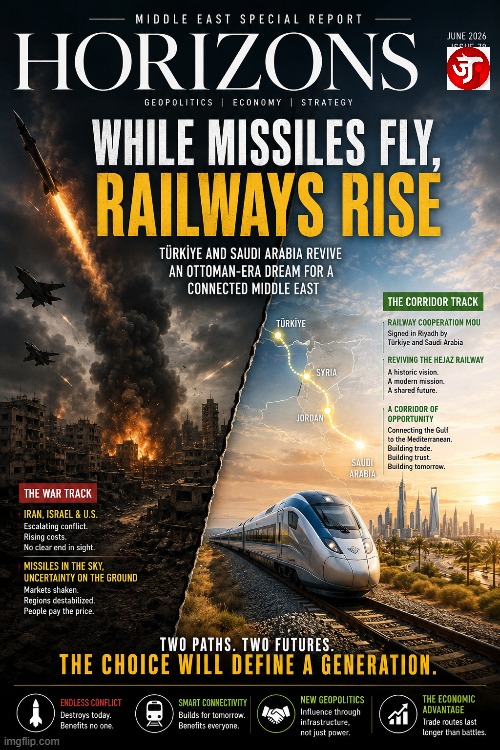
As the Middle East remains consumed by escalating tensions between Iran, Israel, and the United States, a very different story is unfolding quietly in Riyadh.
While billions of dollars are being spent on missiles, air defenses, military deployments, and war preparations, Tukiye and Saudi Arabia have chosen to invest in something else entirely: railways, trade routes, and economic integration.
This week, Ankara and Riyadh signed a major railway cooperation memorandum, advancing plans for a modern rail corridor linking Saudi Arabia to Türkiye through Jordan and Syria. To many observers, the project represents the revival of the historic Hejaz Railway, an Ottoman-era network that once connected much of the Arab world with Istanbul.
The timing is striking. On one side of the region, Iran, Israel, and the United States remain trapped in a never-ending cycle of confrontation. Missile strikes are followed by retaliatory attacks. Military victories are claimed, yet the political map remains largely unchanged. The conflict continues to take lives, add sorrow, consume resources, destabilize markets, and create uncertainty across the region.
On the other side, Türkiye and Saudi Arabia are discussing logistics hubs, freight corridors, reconstruction projects, and cross-border infrastructure that could shape trade for generations.
The contrast raises an important question: Which approach is more likely to define the future of the Middle East – endless military confrontation or economic connectivity?: Somewhere, down the line, they lost it. nobody knows what they are fighting for anymore, because every few days, some new trigger comes up.
The Return of a Forgotten Ottoman Vision
Meanwhile, on the other side of the region, something older and wiser is working. More than a century ago, the Ottoman Empire launched one of the most ambitious infrastructure projects in its history.
The Hejaz Railway, completed in 1908 under Sultan Abdulhamid II, was designed to connect Damascus to Medina and eventually link the holy cities of Arabia to the imperial capital in Istanbul. The railway dramatically reduced travel times, facilitated trade, and strengthened economic links across Ottoman territories.
World War I and the collapse of the Ottoman Empire brought that dream to an end. The railway was damaged during the Arab Revolt, fragmented by new borders, and gradually abandoned. For decades, its stations stood as monuments to a vanished era.
Today, however, the idea is returning in a new form. Instead of serving an empire, the modern corridor would serve sovereign states seeking economic growth and regional integration. If completed, trains could eventually move goods from the Gulf through Saudi Arabia, Jordan, and Syria into Türkiye and onward to Europe.
Thus, Türkiye and its Middle Eastern partners are moving to revive key sections of the historic Ottoman-era Hejaz Railway, while Iraq and Iran are simultaneously developing rival rail corridors of their own. Together, these ambitious infrastructure projects are reshaping trade routes across the Middle East, creating new links between Asia, the Gulf, and Europe, and transforming the future of Eurasian supply chains.
Building While Others Fight
Perhaps the most significant aspect of the project is that it comes at a moment when the Middle East faces one of its most dangerous security crises in years. The Iran-Israel confrontation has expanded beyond rhetoric into direct military exchanges. American forces remain deeply involved. Shipping routes face periodic threats. Investors remain nervous. Energy markets react to every escalation.
Yet despite this environment, Türkiye and Saudi Arabia are betting that the region’s future will not be determined solely by military power. Instead, they appear to be pursuing a strategy centered on trade corridors, infrastructure, and economic influence.
Unlike wars, railways create assets rather than destroy them, railways transport corridors generate commerce, unlike missile exchanges, growth often requires cooperation between former rivals to build their projects, unlike military campaigns.
Syria’s Unexpected Return
The railway project also highlights another major geopolitical shift: Syria’s gradual return to regional relevance. For years, Syria was viewed primarily through the lens of civil war and destruction. Now, geography is making the country important once again. Any direct rail connection between Saudi Arabia and Turkiye must pass through Syrian territory.
As a result, Damascus is increasingly being viewed not as a battlefield but as a transit hub connecting the Gulf to the Mediterranean and Europe.
This represents a remarkable transformation for a country that spent more than a decade isolated by conflict.
The Real Battle for the Middle East
The most important struggle in the Middle East may no longer be fought only with fighter jets, drones, and missiles. It may also be fought through ports, railways, energy corridors, and logistics networks. History shows that military victories can be temporary. In fact, there are exhaustive, traumatic, and cruel, with all the death toll and misery, doesn’t a land need billions to be restored again? On the other hand, trade routes bring more victory and connectivity.
That is what makes the Türkiye-Saudi railway initiative so significant.
While headlines all over the world focus on war, another contest is underway -a contest over who will build the economic architecture of the future Middle East.
One side is investing in confrontation.
The other is investing in connectivity.
And decades from now, the railways may prove more influential than the missiles.