
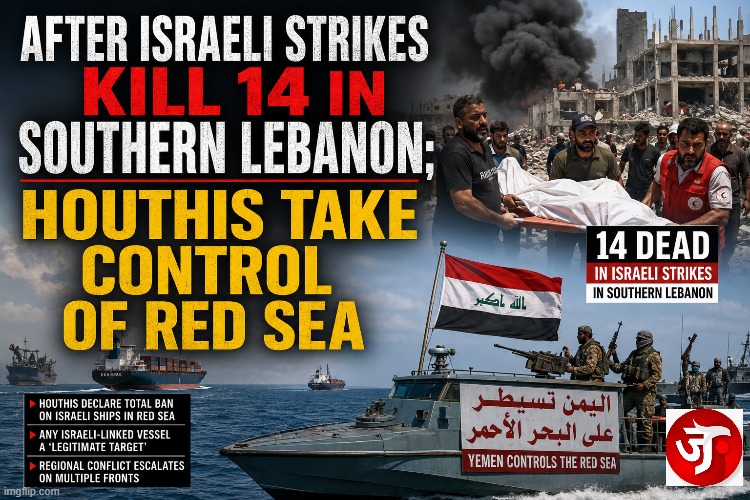
Iran-backed Yemen’s Houthis on Monday said they had launched a missile attack on Israel and imposed a “total ban” on Israeli vessels passing through the Red Sea.
Iran-backed Yemen’s Houthis on Monday said they had launched a missile attack on Israel and imposed a “total ban” on Israeli vessels passing through the Red Sea. This was after Israeli forces killed at least 14 people and wounded dozens in air attacks across southern Lebanon after Iran warned of “crushing measures” if Israel presses ahead with its assault on the country.
The announcement came as Iran and Israel exchanged strikes on Monday for the first time since a fragile ceasefire paused weeks of fighting in April, raising fears that the escalation could trigger a new full-scale conflict.
The Houthis have previously blocked cargo ships in the Red Sea during the Israel-Hamas war, forcing many companies to take lengthy detours around southern Africa. Their latest threat comes amid continued tensions at the Strait of Hormuz, the main gateway to Gulf energy exports, which remains effectively blockaded by Iran.
“We declare a complete and total ban on Israeli maritime navigation in the Red Sea,” said a statement from the Houthis’ armed forces. “All enemy movements are considered legitimate military targets from the moment this statement is issued.”
The Red Sea is a key global trade route, carrying a significant share of oil and container traffic through the Bab el-Mandeb strait. Any disruption could have wide-reaching economic consequences, including shipping delays and higher freight costs.
The Houthis, who joined the Middle East war in support of Iran in March, had not announced a missile attack on Israel since the ceasefire began on April 8. In Monday’s statement, they said they had “launched a missile barrage targeting sensitive Israeli enemy targets” and claimed the strikes “achieved their objectives with precision.”
The Israeli military earlier confirmed on Telegram that it “has identified the launch of a missile from Yemen toward Israeli territory” and that aerial defence systems were operating to intercept the threat.
The attack comes as Israel and Iran continue to trade strikes, putting the fragile ceasefire under renewed strain and threatening prospects for a peace agreement. The Houthis, along with Lebanon-based Hezbollah, form part of the “Axis of Resistance,” a pro-Iran grouping opposed to Israel and the United States.
Israel has contined it’s airstrikes in the midst of a peace deal trying to be made, unsettling the seas around the vicinity: The deathtoll is morbid, but numbers are imperfect due to access issues, propaganda from all sides, and the difficulty distinguishing combatants from civilians.
Israeli Air Raids -Operation Long Arm, July 2024, which is ongoing, that started on 20 July 2024 was in response to Houthi attacks. Significant civilian harm recorded, including high-casualty incidents (e.g., one September 2025 month alone: 427 civilian casualties, including 103 children). YDP maintains a separate, regularly updated dataset. Israeli strikes have caused hundreds of civilian deaths and injuries, with notable spikes in 2025.
The Houthis (Ansar Allah) have faced sustained military pressure and airstrikes from multiple foreign actors since 2015, which they consistently describe as aggression and harassment. The Saudi-led coalition conducted over 25,000 airstrikes between 2015 and 2022, causing thousands of civilian casualties and widespread destruction of infrastructure in Houthi-controlled areas.
After a 2022 truce reduced Saudi operations, the group encountered renewed campaigns: US and UK forces launched hundreds of strikes (notably Operation Poseidon Archer in 2024 and the intense Operation Rough Rider in March–May 2025), targeting weapons sites, radars, ports, and fuel facilities, with reports of hundreds of deaths including civilians. Israel has carried out repeated long-range airstrikes since mid-2024 (Operation Long Arm and subsequent operations), hitting ports like Hodeidah, Sanaa airport, military camps, and leadership targets in retaliation for Houthi missile and drone attacks on Israeli territory. The Houthis frame these actions, combined with naval blockades, sanctions, and targeted killings, as a coordinated campaign of external harassment aimed at weakening their control over northern Yemen and punishing their support for Palestinian causes.