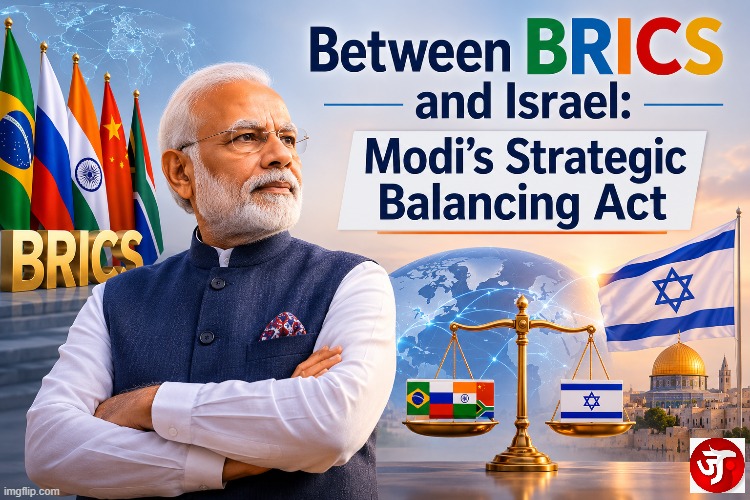
India Walks a Different Path on BRICS While Deepening a Pro-Israel Engagement.
In December 2024, External Affairs Minister S. Jaishankar stated there was “no proposal” for a BRICS currency and that “India has never been for de-dollarization.” He emphasized that India has no interest in weakening the US dollar.
February 4, 2025 gave the strongest and most direct early rejection from Union Commerce Minister Piyush Goyal who said during a press conference at the IT-BT Roundtable 2025: “We are on record – We don’t support any BRICS currency. Imagine us having a currency shared with China. We have no plans. It is impossible to think of a BRICS currency.”
India has signaled that it does not support the creation of a common BRICS currency, emphasizing the importance of maintaining its monetary independence and protecting its national economic interests.
Indian policymakers have consistently stressed the need to retain control over the country’s monetary and financial policies. A shared currency arrangement would require significant coordination among BRICS members, potentially limiting India’s flexibility in responding to domestic economic challenges.
India’s cautious approach is also shaped by broader geopolitical realities. Longstanding strategic differences and border disputes with China have made New Delhi wary of any arrangement that could concentrate excessive influence in the hands of a single member state. Analysts note that concerns about maintaining an independent voice within BRICS remain an important factor in India’s position.
The U.S. dollar continues to play a central role in India’s international trade and financial transactions. A large share of India’s global commerce, including sectors such as technology, energy, and pharmaceuticals, is conducted in dollars. Maintaining this framework provides stability and predictability for businesses engaged in cross-border trade.
India’s position may complicate efforts by some BRICS members to pursue deeper monetary integration or develop alternatives to the dollar-dominated financial system. Countries such as China and Russia have advocated expanding the use of local currencies and reducing reliance on the U.S. dollar, but a fully unified BRICS currency remains a complex and distant prospect.
While rejecting the idea of a common BRICS currency, India has continued to support limited bilateral trade settlements in local currencies with selected partners. These arrangements are designed to facilitate trade and reduce transaction costs rather than replace the global role of the U.S. dollar.
India’s stance reflects a combination of economic pragmatism, strategic caution, and a desire to preserve policy autonomy. While discussions on de-dollarization and alternative payment mechanisms are likely to continue within BRICS, New Delhi appears committed to pursuing a flexible approach that protects its national interests while maintaining stability in international trade and finance.
Contrary to viral claims, New Delhi has not opposed trade in local currencies. India already conducts significant transactions in national currencies with several partners and has actively promoted alternatives to traditional payment systems. What India has firmly resisted is the idea of a unified BRICS currency or any effort to transform the bloc into an openly anti-dollar alliance.
However, pushing out the BRICS, could result in missed cost savings and trade friction , strain ties with Russia and China who are India’s key partners for oil/defense, who see it as prioritizing the West; and this may weaken India’s influence as 2026 BRICS chair on ambitious agendas; and leaves India in the swamp with a continued dollar dependence, exposed to US policy swings, potential tariffs, and sanctions risks, without faster diversification benefits that others might gain. India mitigates this via bilateral deals and CBDC linkages. Effects are pragmatic trade-offs rather than major setbacks.
At the same time, Prime Minister Narendra Modi’s close engagement with Israel continues to attract attention. Since becoming the first Indian Prime Minister to visit Israel in 2017, Modi has overseen a dramatic expansion of defense, technology, intelligence, and strategic cooperation between the two countries.
While India officially supports a two-state solution and maintains ties with Palestine, its partnership with Israel has become one of the defining features of its foreign policy in the Modi era.
Together, these positions reflect a broader strategy: India is seeking to maximize its national interests without fully aligning itself with any single geopolitical camp – whether in the BRICS bloc or the wider Middle East.