
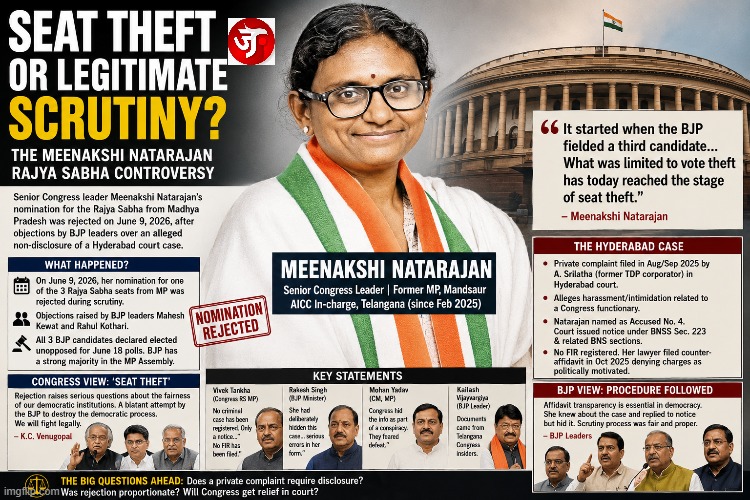
The Indian National Congress (INC) is currently in a state of aggressive protest and damage-control mode following the rejection of Meenakshi Natarajan’s Rajya Sabha nomination, but the incident itself represents a tactical setback rather than a fundamental shift in the party’s overall position.
A dramatic political battle has erupted in Madhya Pradesh after the rejection of senior Congress leader Meenakshi Natarajan’s nomination for the Rajya Sabha, a move that handed all three Upper House seats to the BJP without a contest and triggered allegations of “seat theft,” institutional bias, and internal party sabotage.
At the centre of the controversy is a seemingly technical question with major political consequences:
Did Meenakshi Natarajan conceal a legally relevant case in her nomination papers, or was her nomination rejected over a matter that did not legally require disclosure?
Who Is Meenakshi Natarajan?
Meenakshi Natarajan is one of the Congress party’s most experienced organizational leaders.
A former Lok Sabha MP from Mandsaur in Madhya Pradesh, she has long been associated with the Congress’s youth and student wings and is regarded as a close political associate of Rahul Gandhi. In February 2025, she was appointed Congress in-charge for Telangana, placing her at the centre of party affairs in one of India’s most politically turbulent states.
Unlike many senior politicians, Natarajan has generally maintained a relatively clean public record, with no major criminal controversies attached to her electoral history.
That makes the events of June 2026 all the more significant.
What Happened?
On June 9, 2026, the Returning Officer for the Madhya Pradesh Rajya Sabha election rejected Natarajan’s nomination papers during scrutiny.
The decision came after objections raised by BJP leaders, who alleged that she failed to disclose a pending legal matter connected to proceedings in Hyderabad.
With the deadline for filing nominations already closed, Congress was unable to replace her. The immediate consequence was politically devastating:
All three BJP candidates were declared elected unopposed, eliminating what was expected to be a contested Rajya Sabha election.
The Hyderabad Case: What Is It?
The controversy revolves around a private complaint filed in Hyderabad in 2025 by former TDP leader A. Srilatha.
According to court records cited by both parties, Natarajan was named as one of several respondents in a complaint alleging intimidation and harassment connected to a dispute involving a Congress functionary in Telangana.
Critically, several facts are not disputed:
No FIR was reportedly registered.
No police investigation was launched.
The matter originated through a private complaint.
Natarajan’s legal team filed a response denying the allegations.
The case had not advanced to trial.
Congress argues that because there was no FIR, charge sheet, arrest, or criminal prosecution in the conventional sense, the matter did not qualify as a criminal case requiring disclosure in nomination papers.
The BJP argues exactly the opposite.
Its leaders maintain that once a candidate has received legal notice from a court and formally responded, disclosure becomes mandatory under election transparency norms.
The disagreement over that interpretation now lies at the heart of the controversy.
Congress’s “Seat Theft” Theory
Congress leaders believe the rejection was not merely procedural. Their argument rests on timing. The dispute intensified after the BJP fielded a third Rajya Sabha candidate despite already controlling a comfortable majority in the Madhya Pradesh Assembly.
Congress leaders claim the ruling party feared a politically embarrassing contest and therefore used technical objections to remove its candidate from the race altogether.
Natarajan herself launched a fierce attack after the rejection.
She accused the BJP of moving from what she described as “vote theft” to “seat theft,” arguing that democratic competition had been eliminated through procedural maneuvering rather than electoral victory.
Senior Congress leaders including K. C. Venugopal, Jairam Ramesh, Sachin Pilot and Bhupesh Baghel publicly protested the decision and vowed a legal challenge. The party now portrays the episode as part of a broader pattern of institutional pressure on opposition parties.
BJP’s Defense
The BJP insists the controversy is far simpler. Its position is that election affidavits are meant to maximize transparency, not minimize disclosure.
According to BJP leaders, Natarajan was aware of the Hyderabad proceedings because her lawyers had already responded to them. If she knew about the case, they argue, omitting it from the nomination papers constituted a material omission.
Chief Minister Mohan Yadav welcomed the Returning Officer’s decision and suggested Congress had attempted to conceal information because it anticipated defeat.
The BJP further argues that scrutiny rules apply equally to all candidates and that the Returning Officer merely followed established procedures.
The Telangana Angle: Internal Sabotage?
Perhaps the most intriguing aspect of the controversy is a claim emerging from within BJP circles themselves. Some BJP leaders have suggested that documents relating to the Hyderabad case were supplied by individuals connected to Congress in Telangana.
If true, this raises the possibility that internal factional rivalries within the Congress may have played a role in exposing the legal notice. No evidence has yet been publicly produced proving such a leak occurred.
However, the allegation has intensified speculation about factional tensions inside the Telangana Congress unit, where competing groups have frequently clashed over leadership and organizational control.
For Congress, that possibility is politically uncomfortable because it shifts part of the story away from BJP-versus-Congress conflict and toward intra-party warfare.
The Legal Questions Ahead: Several unresolved legal questions could determine the outcome of any challenge:
- Does a private complaint qualify as a disclosable criminal proceeding?
If courts conclude that the Hyderabad matter legally required disclosure, the Returning Officer’s decision may be upheld.
- Is an unregistered complaint equivalent to a criminal case?
Congress argues it is not.
Election law experts are divided on where disclosure obligations begin.
- Was rejection proportionate?
Even if disclosure was incomplete, courts may examine whether outright rejection was the correct remedy.
- Was the scrutiny applied consistently?
Congress is expected to argue selective enforcement if similar omissions by other candidates have not resulted in disqualification.
Why This Matters Beyond One Seat
The dispute extends far beyond Meenakshi Natarajan.
It touches on a larger national debate over:
Election transparency.
Candidate disclosure requirements.
Powers of Returning Officers.
Use of technical objections in elections.
Fairness of democratic institutions.
For Congress, the case is being framed as a test of democratic integrity.
For the BJP, it is being presented as a straightforward case of enforcing accountability and disclosure norms.
The Bottom Line, at present, two competing narratives dominate the political battlefield.
Congress says a Rajya Sabha seat was effectively taken away through an aggressive interpretation of nomination rules.
The BJP says a candidate failed to disclose legally relevant information and must face the consequences.
The truth may ultimately depend on how courts interpret a single legal question: whether a private complaint notice that never became an FIR or formal prosecution, and had no real connection with Natarajan, as well was significant enough to require disclosure.
Until that question is settled, the Meenakshi Natarajan controversy will remain one of the most consequential election disputes of 2026-because it is no longer just about one candidate or one seat.
It is about who gets to define the rules of democratic competition itself.