
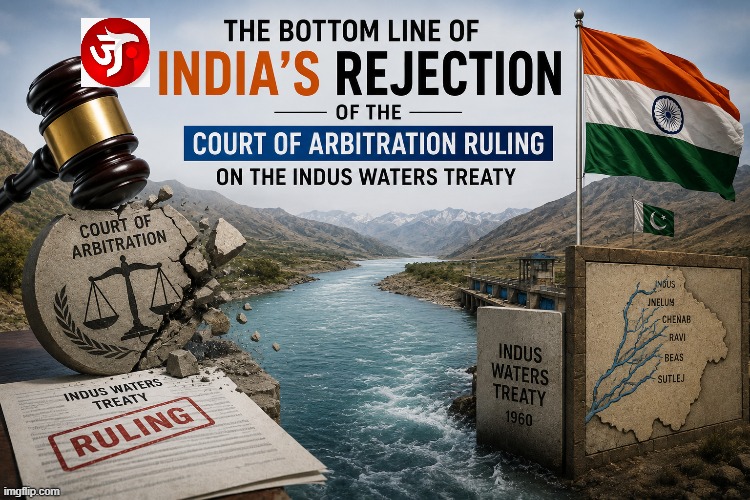
A striking question surfaced during a recent Pakistani briefing: “India has rejected the Court of Arbitration’s ruling on the Indus Waters Treaty. Pakistan’s case is stuck. We will face a water shortage. Soon, rain will come, and destruction will follow. Do we have any levers with India?” The question captures something far deeper than a legal dispute. It reflects Pakistan’s growing fear that one of the most important water-sharing agreements in the world, the Indus Waters Treaty (IWT), is entering its most dangerous phase since it was signed in 1960.
For decades, the treaty survived wars, terror attacks, military crises, and diplomatic freezes. It was often described as the last functioning bridge between India and Pakistan. Today, that bridge is visibly cracking.
The Immediate Trigger: The current crisis began after the April 2025 terror attack in Pahalgam, Jammu and Kashmir, which India blamed on Pakistan-backed militants. After that attack, India suspended participation in the Indus Waters Treaty framework, declaring that “business cannot continue as usual” while cross-border terrorism persists. Since then, India has repeatedly rejected the authority of the Permanent Court of Arbitration (PCA) in The Hague, calling it “illegally constituted” and describing its rulings as “null and void.”
The latest escalation came on May 15, 2026, when the Court of Arbitration issued a supplemental award concerning “maximum pondage”, essentially the amount of water storage India can maintain at hydroelectric projects like Kishanganga and Ratle on the western rivers allocated largely to Pakistan under the treaty. The court sided largely with Pakistan’s interpretation, arguing that strict limits exist on India’s ability to manipulate or store water flows. India rejected the ruling almost immediately. And therein lies the core problem: Pakistan may possess legal arguments, but India controls the geography.
This Old Treaty is Built on Survival, Not Friendship: The Indus Waters Treaty was never based on trust or goodwill. It was born from necessity brokered by the World Bank in 1960, the treaty divided the Indus river system between the two countries, where India received control over the eastern rivers – Ravi, Beas, and Sutlej, and Pakistan received rights over the western rivers – Indus, Jhelum, and Chenab.
Pakistan’s dependence on these western rivers is existential. Nearly 80-90% of its agriculture depends directly or indirectly on the Indus basin. Punjab and Sindh – the country’s agricultural heartlands rely heavily on predictable river flows which is why water has always remained one of Pakistan’s deepest strategic anxieties. For decades, India largely adhered to the treaty even during periods of extreme hostility. That restraint helped preserve a fragile understanding that water would remain outside the battlefield. Now that assumption is eroding.
Pakistan’s concerns are not entirely imaginary or exaggerated. Even though India cannot “turn off” the rivers overnight, the suspension of treaty cooperation creates several practical dangers:
- Data sharing has been disrupted under the treaty, both countries exchanged hydrological data, flood warnings, and technical information. That system reduced uncertainty during monsoon seasons and dry periods. Without timely information, Pakistan faces greater flood vulnerability during heavy rains, irrigation planning becomes harder, reservoir management becomes riskier. Water systems depend as much on predictability as on volume.
- India is accelerating hydropower projects: India has reportedly intensified work on projects like Kishanganga and Ratle. Pakistan fears these projects could eventually give India greater operational flexibility over water timing – even if not outright diversion. The issue is less about “stealing rivers” and more about strategic control over timing, storage, and release. In South Asia, timing is power.
The coming monsoon season will become an early test of how dangerous this crisis could become. Several risks exist simultaneously: Excessive rainfall could trigger flooding without proper data coordination; poor reservoir communication could worsen downstream impacts; reduced dry-season flows could intensify irrigation pressures. Yet predictions of inevitable “destruction” remain premature. The situation is serious, but not yet uncontrollable. What matters now is whether both sides maintain at least minimal technical coordination despite political hostility. Because rivers do not recognize borders, ideology, or nationalism. And once water systems destabilize, the consequences rarely stay confined to one country.
- Climate change is making everything worse: The Indus basin is already under enormous stress: Himalayan glacier melt, erratic monsoons, heatwaves, declining groundwater, and rising agricultural demand. The treaty was designed in a very different climatic era. Today, climate volatility magnifies every political dispute. One season of poor coordination during floods or droughts could produce devastating consequences.
Can India Actually Choke Pakistan’s Water? Not immediately – and not completely. This is where rhetoric often overtakes engineering reality. India currently lacks the large-scale storage infrastructure needed to stop or divert the western rivers fully. The geography and river volumes make total control extraordinarily difficult. However, India does possess the ability to alter the timing of water releases, increase storage capacity over time, conduct reservoir flushing, accelerate dam construction, and reduce cooperation mechanisms. That creates uncertainty, and it can become a strategic tool in its own right. Pakistan’s fear is not necessarily that India will “dry up the Indus tomorrow,” but that, over the next decade, India could gradually acquire greater leverage over flows.
The PCA ruling is seen as an important diplomatic and moral victory. Internationally, it reinforces the argument that treaties cannot be unilaterally suspended. But the reality is uncomfortable: the PCA lacks a powerful enforcement mechanism to compel India. This is the central contradiction of international law: legal legitimacy does not always translate into practical power.
India’s calculation appears clear – national security concerns override treaty obligations, and terrorism fundamentally changes the terms of engagement. Pakistan can continue legal proceedings and diplomatic campaigns at the UN, World Bank, and climate forums. It may gain sympathy internationally. But unless India changes its political position, those victories remain largely symbolic.
At the moment, Pakistan’s options are limited. Pakistan can internationalize the issue through global legal forums, climate-security discussions, and international media narratives. This may shape opinion but is unlikely to force India’s hand directly.
Pakistan may attempt to tie water disputes into broader bilateral negotiations. But India’s position increasingly links restoration of normal engagement to visible action against cross-border militancy.
A military escalation remains extremely dangerous and unlikely. Water wars are often discussed dramatically in media headlines, but in reality, both nuclear-armed countries understand the catastrophic consequences of escalation.
Economic pressure, too, has very little leverage here. Trade ties remain limited and fragmented. In practical terms, Pakistan currently has few tools capable of compelling India to reverse course.
India’s Changing Strategic Doctrine: Perhaps the most important development is psychological rather than legal. For decades, India treated the Indus Waters Treaty as untouchable – a symbol of responsible state behavior despite conflict. That restraint now appears to be fading. A growing strategic school within India argues – why should India continue exceptional concessions while facing repeated terror attacks? – why should water cooperation remain insulated from security realities? The suspension of the treaty framework signals a broader transformation in Indian policy: security issues are no longer being compartmentalized. This shift may prove more significant than any single court ruling.
And perhaps the most troubling reality is this: both countries may ultimately lose if the treaty fully collapses. Because treaties are not only about water. They are about preventing fear from becoming permanent. The future stability of South Asia depends upon their technical coordination.
The Bottom Line: India’s rejection of the Court of Arbitration (CoA/PCA) ruling is rooted less in “fear” and more in a combination of sovereignty, security strategy, and long-term geopolitical calculation.From India’s perspective, this is not simply a technical water dispute anymore. It has become tied to terrorism, national security, and control over strategic leverage. It’s a matter of India’s soverign right while marking out it’s taking cognisanze of national interest first. Once water becomes fully absorbed into nationalist conflict, compromise becomes politically toxic on both sides.