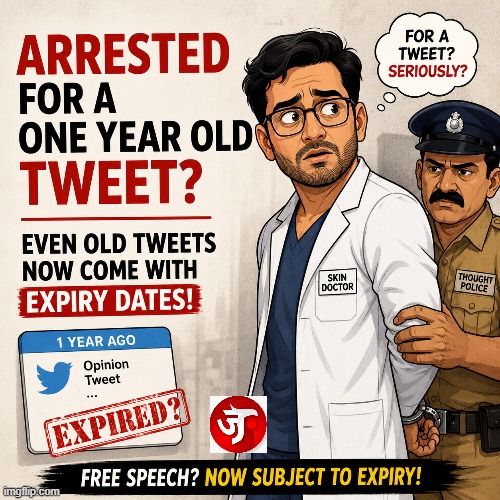
Dr Neelam Singh, a dermatologist and social media influencer known as “The Skin Doctor,” was arrested by Delhi Police on Wednesday, May 13, 2026, following allegations linked to the Kapur family after businessman Sunjay Kapur’s death.
In today’s India, perhaps nothing feels more fragile than the line between public opinion and criminal suspicion. A tweet, incidentally, a one year old, which was already deleted, and buried under the endless avalanche of social media noise, was enough to trigger an arrest.
Dr. Neelam Singh, a dermatologist and social media influencer popularly known as “The Skin Doctor,” was arrested by Delhi Police after allegations connected to the Kapur family’s sprawling inheritance battle following the death of businessman Sunjay Kapur. Within hours, he was granted bail. The magistrate reportedly observed that there appeared to be neither criminal intent nor any meaningful offence serious enough to justify custodial action.
The incident has sparked a much larger question – one that stretches far beyond celebrity families, influencers, or viral tweets. What exactly is the role of the police in a democracy increasingly shaped by outrage, influence, and online speech?
Here is a Billionaire Family Feud in Public View
Sunjay Kapur’s death in June 2025 was already surrounded by intense media attention. The businessman, known for his high-profile corporate and personal life, died in London while playing polo, with reports later confirming heart-related causes. Sunjay Kapur, billionaire, Indian multinational industrialist was the chairman of Sona Comstar, an automotive component manufacturer. His death on June 12, 2025, in Windsor, England was so sudden, that it did spark speculations.
But death rarely ends conflict where immense wealth is involved. Soon, a fierce legal battle reportedly erupted around his estimated ₹30,000 crore estate. The dispute involved family members, including his widow Priya Sachdev Kapur, his mother, and children from previous relationships. The matter became so dramatic and publicly contested that even the Supreme Court reportedly likened the feud to the Mahabharata while appointing a mediator. In such an atmosphere, speculation was inevitable.
Television panels debated succession. Social media users dissected timelines. Anonymous handles spun theories. Influencers joined conversations. Every detail became fuel for public curiosity.
Somewhere in that digital storm, Dr. Singh posted a tweet questioning the timing and authenticity of the will. The post allegedly hinted that the will appeared “hurried” given the proximity to Kapur’s death.
The tweet reportedly disappeared later. But a year later, the police arrived anyway. Late, that May 13th night, even though one may not be a fan of the Skin Doctor, having detrimental viewpoints, there is something deeply unsettling about the image of a citizen being arrested over commentary tied to a public inheritance dispute.
All public figures should be immune from criticism, yet it was obvious that this criticism was increasingly vulnerable. Even if the tweet made by the Skin Doctor was inaccurate, speculative, insensitive, or even influenced by sponsorship, as some online accounts alleged, “a paid tweet”, did it warrant an arrest?
In such a situation, one can ask for a clarification, a rebuttal, a legal notice, a civil defamation suit, raise public criticism, but arrest for a one-year-old deleted tweet? That is where the discomfort begins.
Democracies survive not because speech is always responsible, but because state power is expected to remain proportional. An arrest is among the most coercive tools available to the government or the people in power. It strips liberty, damages reputation, and carries the force of public humiliation even before guilt is proven. When used casually in matters involving opinion or commentary, it sends a dangerous message, not merely to the accused, but to society at large.
The message the powerful send to the public is “Speak carefully, or else, dekhunga – a veiled or open threat. So, a tweet, meme, satire, and old social media posts are setting waves of a chilling effect nobody talks about
Perhaps the most damaging consequence of such arrests is not what happens in court, but what happens quietly afterwards. Because of this, writers hesitate to pour out their thoughts on paper, journalists soften language, influencers delete posts, ordinary citizens stop speaking altogether or shy away from social media or even public speeches.
It was interesting to note that when the news of the Skin Doctor’s arrest came out, comments were floating around social media, such as “How scary, it’s better to leave X if this is going to happen.” People also asked in surprise, “But what was wrong with what he said?” There were others who jeered him, happy that he was arrested.
But underlying the crowd was fear: The fear does not always come from conviction or punishment. Often, the process itself becomes the punishment. Lingering at the back of the mind is the fear of police complaints, interrogations, legal costs, media trials, the humiliation of arrest, and even temporary detention can permanently alter careers, mental health, and public reputation.
This is why the issue surrounding Dr. Singh’s arrest resonates far beyond celebrity gossip or internet drama. It taps into a growing public anxiety – that criminal law is increasingly being used not only to punish wrongdoing, but also to discourage uncomfortable speech.
Every few months, another individual finds themselves facing police action over online expression, particularly when the subject involves influential personalities or politically sensitive matters.
Each case chips away at public trust, and this is not because citizens believe all online speech is noble or truthful, but rather whether the machinery of law is being applied equally.
The Power of Influence in Modern India
India today is a country where wealth, celebrity, and digital influence intersect constantly. The rich no longer fight quietly behind closed doors, their disputes trend, their family conflicts become content for gossip and news, their court cases become public spectacle which can turn ugly, reckless, invasive, and unfair. But it is also part of modern public life. Once a story enters the public domain, especially one involving billionaires, inheritance battles, and national media attention, people will comment. Some responsibly and some irresponsibly.
The answer to questionable speech cannot always be criminalization and when this happens, the law risks becoming a shield not for justice, but for influence.
This is precisely why the magistrate’s reported observations matter so much. The court’s apparent skepticism about the arrest, and the speed with which bail was granted, suggested a troubling mismatch between the alleged offence and the state’s response. Senior advocate Mahesh Jethmalani reportedly called the case “baseless and frivolous.” That description captures what many observers felt instinctively.
If there was no serious criminal intent, why the arrest, if no immediate threat existed, why the urgency? If the issue was reputational harm, why not pursue civil remedies? These questions linger.
Beyond one tweet, at its heart, this story is no longer really about Dr. Neelam Singh, no is it solely about the Kapur family, but rather the uneasy relationship between power and dissent in the digital age.
A mature democracy must tolerate skepticism, gossip, criticism, speculation, and even foolish opinions, especially in matters involving public figures and highly public disputes.
That tolerance becomes most important precisely when the speech is inconvenient. Because once arrests become normal responses to commentary, fear quietly replaces freedom. This is when people stop asking questions and a society that stops asking questions lose their ability to reason intelligently, and stop holding incidents, events, and power accountable.
The legitimacy of a democracy is not tested by how it treats agreeable speech, but how it handles uncomfortable speech.
There is, of course, a line between free expression and malicious falsehood. Genuine defamation, fabricated evidence, and coordinated disinformation campaigns deserve scrutiny under law, but scrutiny requires evidence, proportionality, and restraint, not performative arrests, not midnight policing of opinions, and not turning criminal law into a public relations instrument.
The image of a dermatologist being arrested over a deleted tweet tied to a billionaire family feud may seem surreal, even laughable, to some. But beneath the spectacle lies something far more dangerous: the growing fear that a single post, opinion, or remark can invite the weight of the state upon an individual.
You may dislike the Skin Doctor. You may strongly disagree with his views. But in a democracy, the law cannot become selective. Justice loses its meaning the moment it stops applying equally to everyone and becomes a weapon for the entitled.