
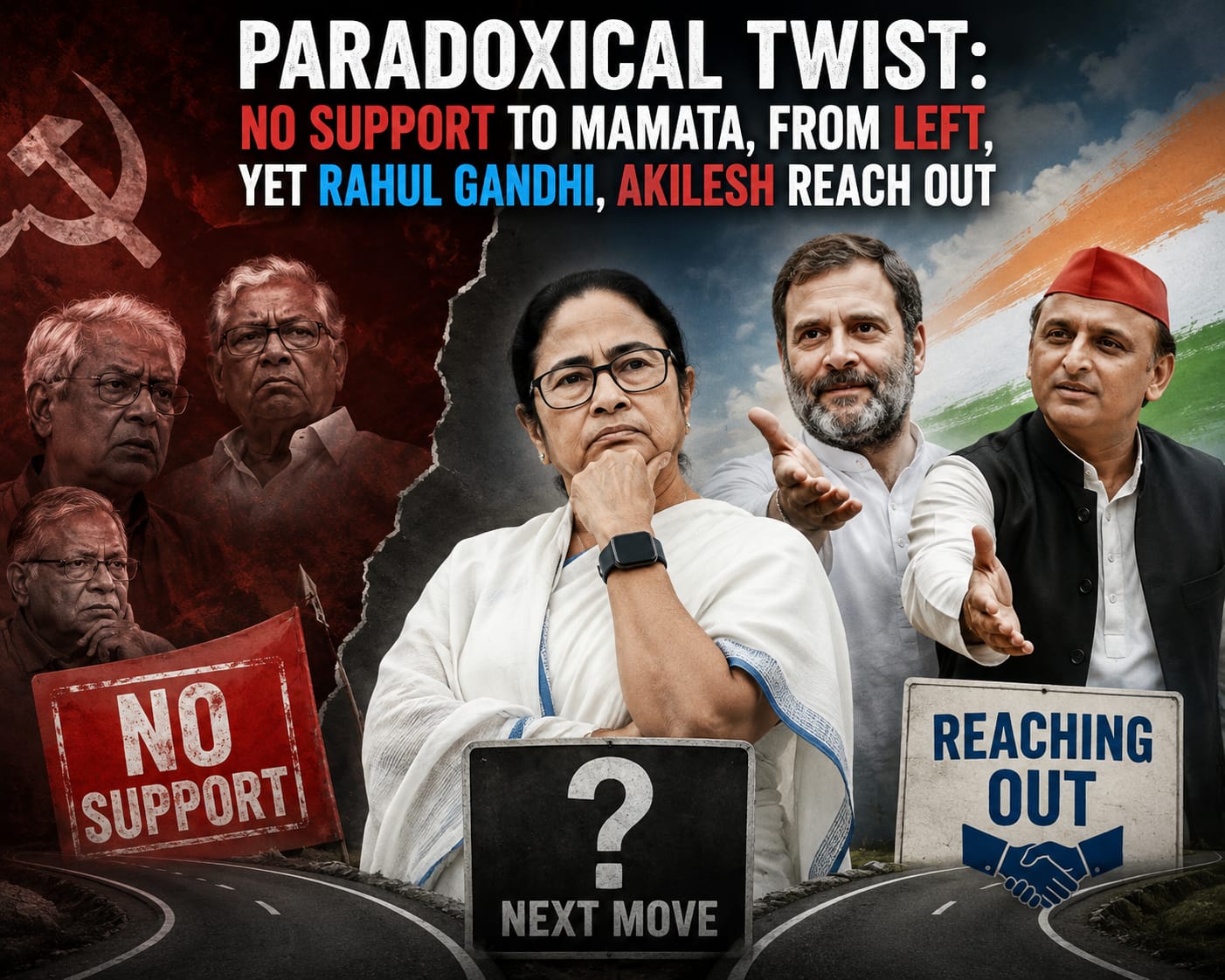
Mamata Banerjee’s recent electoral setback in West Bengal has thrown into sharp relief the paradoxes that define her politics, and the deeper fault lines within India’s opposition.
After alleging widespread irregularities (CCTV cameras switched off, power blackouts at strongrooms, unauthorised BJP vehicles near counting centres), she issued a clarion call for a united front against the “enemy” BJP. The Left and the state Congress responded with a flat refusal: “We won’t accept any criminal.” Adhir Ranjan Chowdhury, never one to mince words, reminded her that she was now seeking shelter from the very parties she had spent years trying to annihilate.
Earlier, when she lost the election, Rahul Gandhi, Leader of Indian National Congress endorsed her claim that “more than 100 seats were stolen,” and framed the defeat not as TMC’s failure but as BJP’s assault on democracy itself. Akhilesh Yadav, the former Uttar Pradesh chief minister, travelled to Kolkata, sat with her, and told her plainly, “You have not lost.”
This is the paradox: local rejection, national outreach. And it forces us to look beyond the headlines at what Mamata Banerjee actually represents.
Her journey has always been a study in contradictions. She rose as a street-fighter, a woman who broke away from the Congress and later dismantled the Left’s decades-old citadel with the sheer force of “Ma, Mati, Manush.” That slogan was never abstract; it was a promise to the rural poor, to the marginalised, to those who felt the old establishment had forgotten them. She delivered on parts of it, such as pensions for widows, cycles and scholarships for girls, Kanyashree, Sabuj Sathi, and a stubborn insistence that the state must stand with the tiller and the fisherman. These were not mere sops; they were lifelines that reshaped Bengal’s social geography.
Yet the same period is stained by a history of political violence that cannot be wished away. TMC cadres have been accused, and in many documented cases, proven, guilty of intimidation, clashes, and outright attacks on Left and Congress workers. The cycle of retribution that began when she was in opposition did not end when she came to power. Trust was shattered. Entire pockets of Bengal still carry the memory of families forced to flee or villages where one colour of flag replaced another through fear rather than persuasion. That violence is her greatest failure, and it is the reason the Left and Congress find it morally impossible to forget, even when they know their own hands are not clean.
Because here is the uncomfortable truth: no party in West Bengal, or indeed in much of India, can credibly occupy the high moral ground on corruption or muscle power. The Left’s own legacy includes land-grab scandals and cadre raj; Congress has its own litany of scams. Power, when held for long, corrupts across ideologies. What the Left and Congress truly fear is not Mamata’s sins alone but her enduring grip on a section of the electorate that once belonged to them. They worry that an alliance would legitimise her dominance rather than dilute it. They suspect her cadres will not migrate easily to red or tricolour flags; the street-level loyalty she commands runs deeper than ideology.
And yet, her secular record stands as a genuine asset, one that deserves honest acknowledgment.
Mamata has practised a lived secularism that feels organic to Bengal’s syncretic soil. She lights up Park Street every Christmas with fairy lights, food stalls, musical performances and a “Walk Street” carnival that draws lakhs turning what was once a quiet colonial lane into a joyous, inclusive festival. She participates in Durga Puja with equal enthusiasm, visits Eid gatherings, and gurdwaras without hesitation. She inaugurated a state-built Jagannath Temple in Digha and calls it proof that public funds can serve every faith. “I am secular in the truest sense,” she has said. “Humanity is our ideology.” Critics label it “soft Hindutva” or “saffron-lite” when she chants “Joy Jagannath.” Supporters, including the Shahi Imam of Tipu Sultan Mosque, see it as the most authentic secularism on offer, which is neither appeasement nor majoritarianism, but a refusal to treat any community as an electoral prop or a political threat.
In an era when one national party seeks to redefine Indianness along a single cultural axis, Mamata’s brand of inclusive populism, flawed, populist, occasionally contradictory, remains a counter-weight. It is not perfect secularism, but it is lived pluralism. That is her strength, and the reason national opposition voices like Rahul and Akhilesh are reaching across the trenches.
So what should the Left and Congress do?
They cannot pretend the violence never happened. They cannot ignore the corruption cases or the erosion of democratic norms under TMC rule. But they also cannot afford the luxury of permanent enmity. The real battle is larger. If the mandate in Bengal and Assam is indeed being “stolen,” as Rahul himself now concedes, then clinging to old vendettas only helps the very force they claim to oppose. A tactical, issue-based understanding, without merging identities or erasing memories, may be the only pragmatic path. Let local units keep their distance where trust is broken; let the national leadership focus on the bigger democratic question. History shows that opposition unity is rarely born of love; it is born of necessity.
Mamata Banerjee is neither saint nor pure villain. She is a product of Bengal’s turbulent politics – brutal, resilient, populist, and, at her core, stubbornly secular in a way that still resonates with millions who want neither majoritarianism nor sterile ideological purity. The Left and Congress must decide whether they are fighting Mamata Banerjee or fighting for the survival of the plural India she, paradoxically, still helps anchor. The answer will shape not just West Bengal, but the contours of national resistance for years to come.