
How the Special Intensive Revision (SIR) of Electoral Rolls Played Out in West Bengal’s 2026 Verdict
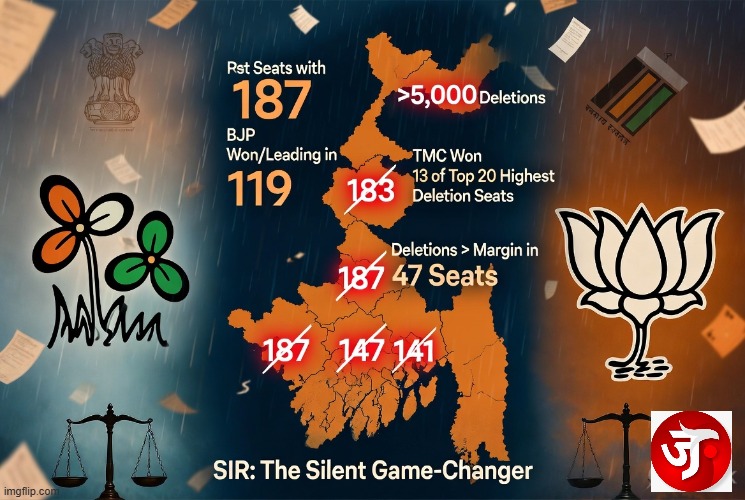
While final deletion figures are still being firmed up, two early trends from the Special Intensive Revision (SIR) of electoral rolls stand out as potentially game-changing in the West Bengal Assembly elections. Of the 20 seats that recorded the highest number of deletions after adjudication, the Trinamool Congress (TMC) still won 13, showing its core base held firm even where rolls were pruned most aggressively. The BJP took six and the Congress one. Yet the broader picture tells a different story: in the 187 seats where more than 5,000 names were deleted, the BJP won or was leading in 119.
In these 187 high-deletion constituencies (full results available for 170, leads for 17), the number of excluded voters exceeded the margin of victory or lead in 47 seats – an analysis by The Indian Express reveals. That is not a trivial number in an election decided by razor-thin margins in many places. Within the BJP’s 119 seats in this category, deletions outnumbered the party’s victory margin in 28 constituencies. Strikingly, 26 of these 28 seats were won by the TMC in 2021. In other words, the SIR appears to have coincided with a decisive shift in a significant chunk of the very battlegrounds the ruling party had dominated five years earlier.
The TMC, for its part, won or was on course to win 65 of the 187 high-deletion seats. In 18 of those, deletions again exceeded the margin, with two going to the Congress and one to the Aam Janata Unnayan Party. The data therefore, paints a nuanced picture: TMC retained many of its strongest redoubts despite heavy pruning, but the BJP capitalised on the exercise in a large number of swing and former TMC seats.
What the SIR Actually Was and Why It Mattered
Unlike the routine annual or pre-election Special Summary Revisions, the SIR. which was ordered by the Election Commission in June 2025 and rolled out first in Bihar, then in West Bengal and other states was far more intrusive. Every registered elector had to fill out fresh enumeration forms and furnish documents proving eligibility, including citizenship. The Supreme Court’s intervention in petitions challenging the process led to unprecedented steps: intensive field verification, adjudication of “logical discrepancies,” and a tighter scrutiny of absentee, shifted, and duplicate (ASDD) entries. Roughly 9–9.1 million names (around 12% of West Bengal’s electorate of 7.6 crore) were ultimately deleted statewide.
The political heat was inevitable. Critics, including the TMC, alleged the exercise disproportionately affected certain communities and border districts, potentially disenfranchising legitimate voters. Supporters of the SIR argued it was a long-overdue clean-up of bloated rolls allegedly stuffed with bogus or non-resident names – a charge that had lingered for years in a state with porous borders and high migration.
The Insight: Correlation, Causation, and Electoral Integrity
The numbers do not prove causation, but the correlation is hard to ignore. In at least 28 seats that flipped from TMC to BJP, the deletions exceeded the final margin. That raises a legitimate question: did the removal of ineligible or unverified names remove a cushion that had previously inflated TMC’s vote share in close contests? Or did it inadvertently suppress legitimate voices in areas where documentation gaps were more common?
What makes the data particularly telling is that TMC still swept the top 20 deletion seats in 13 cases. This suggests its organisational muscle and loyal voter base proved resilient even under maximum scrutiny. The BJP’s gains, therefore, came not by cracking TMC’s deepest strongholds but by winning the battle in the middle – the 187 high-deletion seats that were more competitive to begin with.
Other factors undoubtedly played a role: widespread anti-incumbency over issues such as the Sandeshkhali violence, the RG Kar hospital case, and governance fatigue after 14 years in power. Yet the SIR brought about a structural change in the electorate itself. In a state long accused of electoral malpractices, the exercise appears to have acted as a leveller, or, depending on one’s view, a disruptor -in precisely the constituencies where the contest was tightest.
Broader Takeaway for Indian Elections
West Bengal’s SIR experience is more than a local story. It is a live test of the tension between two democratic imperatives: the integrity of the voter list and the right to vote. The Supreme Court-mandated safeguards tried to strike that balance, but the scale of deletions (12% is extraordinary even by Indian standards) and their geographic-political pattern will fuel debate for years. Did it restore faith in the roll, or did it tilt the field? The answer may lie somewhere in between – the same 47 seats where deletions exceeded margins also happened to be the ones the BJP needed most.
As final SIR numbers are locked and the Election Commission releases its full report, one thing is already clear: the 2026 West Bengal verdict was not decided only on the campaign trail or by anti-incumbency waves. A quieter, more technical process, the most rigorous voter-list revision in recent memory, appears to have redrawn the battlefield in ways that favoured the challenger in dozens of closely fought seats. In the world of Indian elections, sometimes the real story is not just who voted, but who was no longer on the list.