
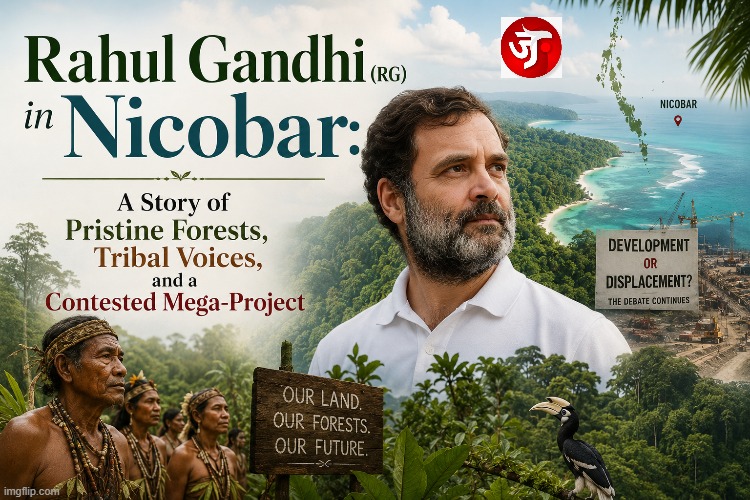
In late April 2026, Rahul Gandhi walked beneath the towering canopy of Great Nicobar’s pristine rainforest – one of India’s last untouched wildernesses. The remote island in the Andaman and Nicobar archipelago is a biodiversity hotspot and home to the indigenous Nicobarese and vulnerable Shompen tribes.
Gandhi had traveled there despite reported administrative hurdles, fulfilling a promise to a tribal delegation that had met him in Delhi earlier. When he arrived, he walked through the lush forest, calling it “easily the most beautiful forest” he had ever seen, and listened as local Nicobarese leaders shared fears of displacement, loss of ancestral lands, and cultural erosion. Gandhi’s visit came amid the Indian government’s ambitious Great Nicobar Island Development Project, a ₹81,000–92,000 crore (roughly $9–10 billion) “holistic development” initiative proposed over decades.
The flashpoint is the government’s massive ₹81,000-92,000 crore Great Nicobar Island Development Project. It aims to reshape 166 square kilometres of the island into a strategic economic powerhouse: a giant International Container Transshipment Terminal at Galathea Bay scaling to 16 million TEUs, a new airport, power plant, townships, and resorts.
Officials argue the project, near the vital Strait of Malacca, will supercharge India’s maritime trade, generate thousands of jobs, bolster defense in the Indian Ocean, and cut dependence on foreign ports.
But Gandhi framed it differently. Standing among the trees, he declared the project “one of the biggest scams and the largest theft of Indian property, of ecological property, that has ever taken place.” He alleged it would fell not just the officially estimated 964,000 trees (possibly undercounted due to dense forest cover, with some critics citing figures closer to millions), but destroy a fragile ecosystem: coral reefs, nesting sites for leatherback turtles, habitats for endemic species like the Nicobar macaque, and a biosphere reserve. He pointed to the timber’s enormous value, “lakhs of crores”, and claimed the real beneficiary would be one businessman: Gautam Adani. “It’s amazing that 160 sq km of this forest is going to be chopped up so that one businessman Mr. Adani can fulfill his fantasies,” he said. Tribal leaders told him over 800 families, including PVTGs, could lose land and livelihoods, with risks of disease from an influx of outsiders (projected population surge to 350,000+ on an island currently home to just a few thousand). Gandhi promised to amplify their voices in Parliament and fight the project.
Adani’s Benefit
Adani Ports & SEZ Ltd. (APSEZ) filed an EOI for developing/operating the Galathea Bay ICTT—one of several bidders. If selected, Adani stands to gain a strategic, high-volume transshipment port in a prime location along global shipping lanes. This would expand their already large port portfolio (they operate 13+ facilities), generate long-term revenue from cargo handling, logistics, and associated infrastructure, and align with their interests in energy and industrial zones. Critics allege the entire project is tailored as a “payout” or crony favour – timber extraction alone could yield massive short-term gains, and the port would lock in decades of profitable operations for a Modi-linked conglomerate. Officially, however, no contract has been awarded yet; it remains open bidding under government oversight.
RG’s Advocacy
Rahul Gandhi’s position centers on environmental protection, indigenous rights, and opposition to alleged crony capitalism. He highlights the human and ecological toll, displacement of tribals who have stewarded the forests for generations, irreversible biodiversity loss, and the prioritization of corporate profits over sustainable development. By visiting the site, meeting affected communities, and using his platform to label it a “scam” and “theft,” he seeks to force national debate, parliamentary scrutiny, and potential course correction. This fits his broader narrative of standing with the marginalized against powerful interests, framing the project not as neutral “development” but as elite capture of public natural resources. Whether this translates into policy change or sustained movement remains uncertain, but it has elevated previously niche concerns into mainstream discourse.
In the end, Great Nicobar tests India’s ability to balance geopolitical strategy, economic growth, and constitutional duties to tribes and ecosystems. Gandhi’s intervention has injected urgency and visibility, but the forests, the tribes, and the bidding process will ultimately decide the island’s fate. Realtime events ranging from April-May 2026 have made eyes turn to Nicobar and Gandhi arguements highlighting environmental protection amid crony capitalism as his central themes. Development or displacement?
The story is far from over.