The city had not slept.
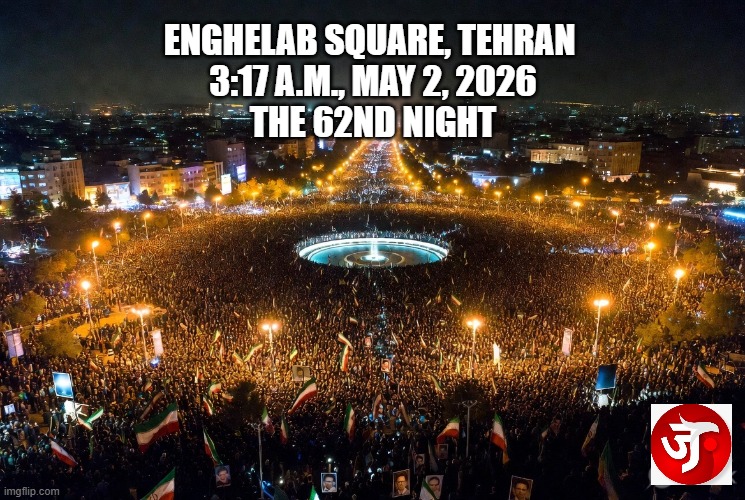
From the moment the last call to prayer faded into the warm spring dark, people had begun drifting out of apartment blocks and narrow alleys, carrying nothing but thermoses of tea and the flags they had kept folded since the first sirens in February. By midnight, the squares were full. By two, they spilled into every intersection, thousands upon thousands, standing shoulder to shoulder under the sodium streetlights.
A young woman in a black chador adjusted her headscarf and lifted a portrait of Ayatollah Ali Khamenei above the crowd. Beside her, an old man with a white beard beat a slow rhythm on a daf drum. The chant rose again, steady as a heartbeat:
“Marg bar Amrika! Marg bar Israel!”
But the newer chant, the one that spread through the night like wildfire, was quieter, almost conversational.
“Why are we out on the streets all night?” a university student shouted into a megaphone.
“At every intersection, thousands gather!” the square answered back.
The student’s voice cracked with exhaustion and something fiercer. “They say this is a fight we wage unarmed. America threatens to erase us – we reply: we’re standing right here… strike if you must.”
The crowd roared. Not in fury, but in recognition.
Sixty-two nights had passed since the first American and Israeli jets crossed the border on February 28. Sixty-two nights of blackouts, of fuel queues that stretched for kilometres, of state television looping the same footage of burning oil terminals and damaged air-defence batteries. The temporary ceasefire had come four weeks earlier, but the Americans still blockaded the ports. The Strait of Hormuz remained sealed by Iranian speedboats and mines. Sanctions are biting harder than ever. Bread prices had doubled again last week.
Yet here they were.
State television crews moved through the throng, lenses glowing red. “Spontaneous outpouring of national unity!” the anchors would declare by sunrise. In the square, no one argued with the cameras. They simply kept chanting – for the Supreme Leader, for the Revolutionary Guards, for the boys who had died defending the skies over Isfahan and Bushehr.
A few blocks away, near a shuttered cafe, a man in his forties named Reza lit a cigarette and spoke low to a foreign journalist who had slipped past the minders. “They say these rallies are forced,” he muttered. “Maybe some are. God knows the regime has crushed protests before, over gasoline, over women’s rights, over the price of eggs. But tonight?” He gestured toward the sea of faces. “Tonight the fear is real. And so is the anger at the sky.”
He exhaled smoke. “We are tired. The children are thin. But if they bomb us again, we will still be standing in this square. That much is true.”
Word of the latest peace proposal had leaked only hours earlier. Iran had sent a fresh document to Pakistani mediators in Islamabad – details still secret, wording still unknown. President Trump had told reporters in Washington that “nobody knows the status of the talks except me and a handful of others,” his tone suggesting the game was still very much alive. Some in the crowd whispered about it like a fragile promise. Others shrugged. They had heard such things before.
At four o’clock the call to morning prayer drifted across the rooftops. The crowd did not disperse. Instead, they knelt together on the pavement, thousands of foreheads touching asphalt still warm from the day’s sun. When they rose, the chants resumed, softer now, almost lullaby-like.
A teenage boy climbed onto a concrete barrier, unfurled a green flag, and began singing an old revolutionary song. His voice was hoarse but clear. Around him, grandmothers swayed, young men raised clenched fists, and somewhere in the back, a mother rocked a sleeping infant against her chest.
The night was almost over. Dawn would bring another day of empty shelves, another day of wondering whether the next missile would fall. But for these hours the people of Tehran had done the only thing left to them when the powerful circled overhead.
They had refused to disappear.
In Enghelab Square, the drums kept beating, slow and stubborn, as the first pale light touched the domes of the city. The 62nd night of the war was ending exactly as it had begun – with ordinary Iranians standing in the open, unarmed, and still here.