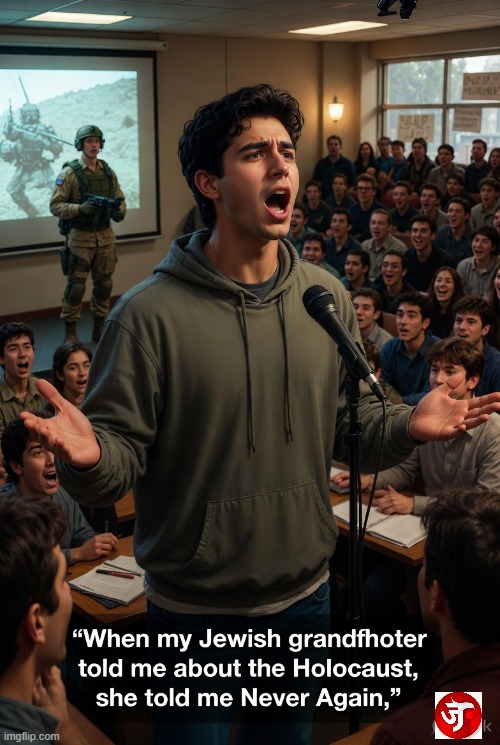
Rutgers University Student Felipe Rendall interrupted an IDF Soldier’s Speech and captured instant attention when he rang strongly, “When my Jewish grandmother told me about the Holocaust, she told me never again.”
In a moment that quickly went viral, a Jewish student at Rutgers University stood up during a pro-Israel campus event on April 24, 2026, and delivered a passionate rebuke of Israel’s military actions in Gaza, framing them as a genocide and invoking his family’s Holocaust history to argue that “Never Again” must apply universally.
The event, organised by the Rutgers chapter of Students Supporting Israel (SSI), featured Yossi Hertz, a former soldier in the IDF’s Hashmonaim Brigade (the first Orthodox Jewish brigade). Hertz was speaking as part of SSI’s “Triggered: From Combat to Campus” tour, sharing his experiences, Jewish identity, and perspective on the ongoing conflict. The talk took place in the College Avenue Student Centre amid external protests by groups like Students for Justice in Palestine (SJP) and the Muslim Public Relations Council, who had gathered a petition with over 6,700 signatures demanding the event’s cancellation.
Midway through Hertz’s presentation, which included videos of IDF training, the student, identified as Felipe Rendall, interrupted. According to footage widely shared by Al Jazeera and across social media platforms, Rendall listed what he described as Israeli atrocities: over 70,000 Palestinian deaths, hundreds of journalists and healthcare workers killed, and the case of a young child (referencing the 2024 killing of Hind Rajab, whom he said was shot 335 times in her family’s car). He then delivered the line that has become the centrepiece of the viral clip:
“When my Jewish grandmother told me about the Holocaust, she told me, ‘ Never again. This is not never again. Never again means never again for everybody.”
Rendall continued, declaring, “If justice is real, then the IDF will go down. You guys will be prosecuted at the Hague… Justice will prevail.” He was promptly ushered out of the room by event staff.
https://x.com/parthpunter/status/2049473309700686168?s=20
A second attendee later challenged Hertz on child casualty figures, to which Hertz responded by asking how many were combatants and emphasising nuance in a complex war. Hertz later told the audience he does not view the IDF or Israeli government as perfect and commended those willing to engage in dialogue.
Updates on Felipe Rendall
As of April 30, 2026, just days after the incident, there are no public reports of disciplinary action, suspension, or arrest against Rendall by Rutgers University. The student has not issued a formal public statement beyond the viral interruption itself, though local campus media (including WRSU) noted his Jewish heritage and his stated intent: he viewed the presence of an IDF soldier on campus as inappropriate given the humanitarian situation in Gaza and the impact on Palestinian families connected to Rutgers students.
The video has been amplified by major outlets like Al Jazeera, CGTN, and pro-Palestine accounts on Instagram, TikTok, and X, where many have praised Rendall as a courageous voice of conscience. Supporters see his actions as a powerful example of Jewish students rejecting what they call the weaponisation of Holocaust memory to justify the Gaza war. Critics, including some Jewish organisations and SSI representatives, argue that such disruptions contribute to a hostile campus environment for Jewish students and that equating Israel’s defensive war against Hamas (following the October 7, 2023 attacks) with the Holocaust is historically inaccurate and inflammatory.
Rutgers itself has not commented publicly on the specific disruption. The broader campus context includes ongoing tensions: SSI co-president Kelly Shapiro noted that Jewish students feel “bombarded with unnecessary hate,” while protesters outside chanted “Free Palestine” and accused the university of platforming potential war crimes.
Why This Moment Resonates
Rendall’s invocation of his grandmother’s Holocaust lessons taps into a deeply personal and universal moral framework. “Never Again” has long been a rallying cry against genocide and mass atrocities. For Rendall and those who share his view, the scale of death and destruction in Gaza, which is now entering its third year, demands that the phrase not be applied selectively. For others, the comparison overlooks Hamas’s role in starting the current war, its use of civilian areas as shields, and Israel’s right to self-defence.
Regardless of where one stands on the Israel-Gaza conflict, Felipe Rendall’s brief but fiery stand has reignited campus debates about free speech, the limits of protest, and what moral consistency looks like in the shadow of history. In an era of polarized protests, his willingness to speak from within the Jewish community, directly to an IDF veteran, has made him a symbol for some and a flashpoint for others.
As the video continues to circulate and the war grinds on, one thing is clear: the conversation Rendall forced into the room is far from over.