
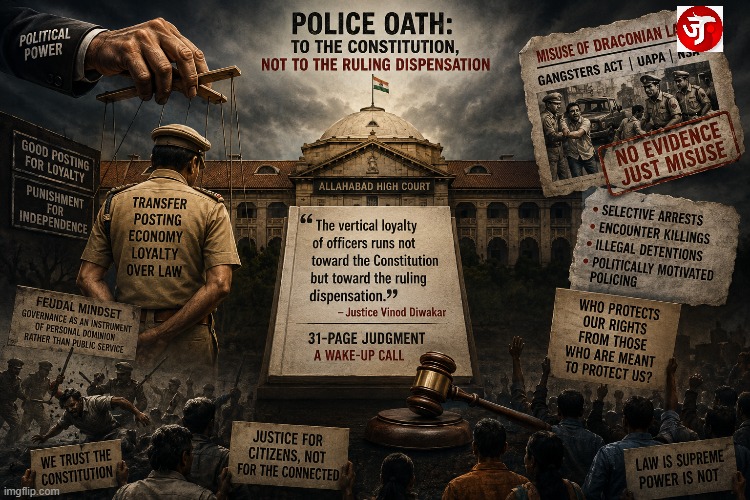
Prayagraj, June 6, 2026: In a scathing 31-page judgment, the Allahabad High Court has delivered one of its strongest critiques yet of the Uttar Pradesh Police, accusing officers of prioritising loyalty to the ruling dispensation over their constitutional oath.
Justice Vinod Diwakar observed: “The vertical loyalty of officers runs not toward the Constitution but toward the ruling dispensation. Field officers, acutely conscious of the transfer-posting economy, calibrate their conduct to satisfy political superiors.”
The court described a “feudal mindset” in the state’s administrative machinery where transfers, postings, and promotions serve as tools of political patronage rather than merit or rule of law. It warned that this culture has reduced governance to “an instrument of personal dominion rather than public service.”
The Case That Triggered the Rebuke: The remarks came while quashing Gangsters Act charges against Rajendra Tyagi, his son Deepak, and daughter-in-law Lalita. The police had invoked the stringent law in what the court called a simple civil property dispute. No evidence of organised crime or gangster activity was found – just misuse of draconian provisions to harass citizens.
The court flagged broader patterns: selective arrests, encounter killings, and politically motivated policing.Background & ContextUP’s Policing Record: Under the current regime, Uttar Pradesh has aggressively used laws like the Gangsters Act, UAPA, and NSA for “law and order.” The government claims this has improved safety and reduced crime. Critics, including opposition parties and human rights groups, allege it is often weaponised against political opponents, dissenters, and in land disputes.
Repeated Judicial Concern: This is not an isolated observation. The Allahabad High Court has repeatedly pulled up UP Police this year on encounter killings, illegal detentions, and failure to follow Supreme Court guidelines (e.g., People’s Union for Civil Liberties guidelines on encounters).
Structural Issue: Officers operate under a “transfer-posting economy” – good postings for loyalty, punitive transfers for independence. This creates strong incentives to please political bosses rather than uphold Article 14, 21, and police duties under the Police Act, 1861.
Why Is This Happening?The court itself explained the root cause: a deeply entrenched political-bureaucratic nexus. Officers understand that career progression depends less on constitutional fidelity and more on alignment with those in power. This leads to:Overzealous application of harsh laws without evidence.
Selective enforcement (tough on some, soft on politically connected).
Routine bypassing of safeguards meant to protect citizens’ rights.
The judgment is a strong reminder that police must serve the Constitution, not any political establishment. It has sparked fresh debate on institutional erosion, with voices like journalist Ravish Kumar asking: if courts are raising these alarms, where does the common citizen turn for justice?