
Since his election on May 8, 2025, Pope Leo XIV has steadily emerged as one of the strongest global moral voices on Gaza. The first Augustinian pope and the second pontiff from the Americas, he has revived the Vatican’s historic emphasis on human dignity amid war and displacement.
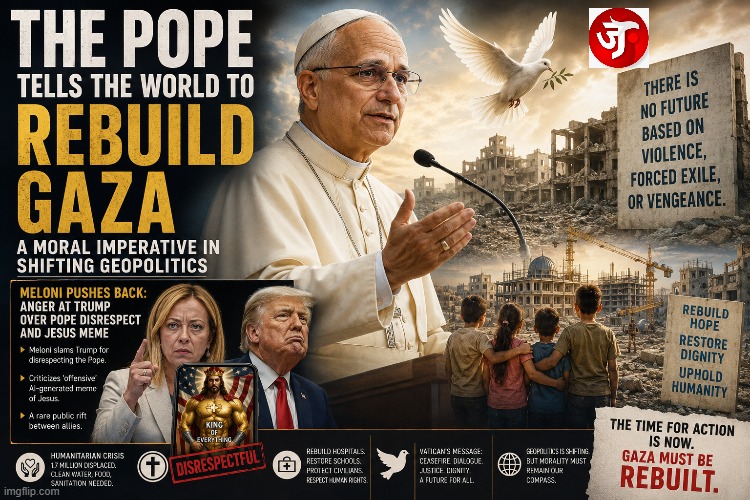
Speaking on May 26, 2026, from Castel Gandolfo, Pope Leo XIV issued a direct and emotional appeal to the world: Gaza must be rebuilt. His remarks came as humanitarian agencies warned of worsening conditions for civilians trapped in the enclave and after international outrage surrounding the Global Sumud Flotilla incident.
“The people of Gaza are still not receiving humanitarian aid sufficiently,” the Pope warned, urging world leaders and authorities to move beyond political paralysis and act decisively.
His message cut through the language of geopolitics with moral clarity: “There is no future based on violence, forced exile, or vengeance.”
The statement echoed decades of Vatican diplomacy while sharpening its urgency for a new era. Pope Leo XIV called for ceasefires, protection for civilians, restoration of hospitals and schools, and adherence to international humanitarian law. Above all, he stressed that collective punishment can never become acceptable policy.
As Gaza enters another punishing summer, nearly 1.7 million displaced people remain crowded into makeshift camps and temporary shelters. Clean water is scarce, sanitation systems are collapsing, malnutrition is spreading, and entire communities remain suspended between survival and ruin. Aid deliveries have reduced the immediate threat of famine in some areas, but the larger reality remains devastating: Gaza requires reconstruction on a massive scale.
The Pope’s position reflects a nuanced balance often lost in global debate. He supports Israel’s right to exist securely while also defending Palestinian dignity, rights, and aspirations for statehood. His vision rejects absolutism and insists that security and humanity cannot be separated.
At the same time, geopolitical winds are beginning to shift. In Italy, Prime Minister Giorgia Meloni, once firmly aligned with Israel, has adopted a more critical tone a few incidents. The flotilla controversy was the most recent one, where she strongly condemned Israeli National Security Minister Itamar Ben-Gvir after he published a video taunting detained activists from the Gaza-bound Global Sumud Flotilla. The activists, including many Italian citizens, were zip-tied and forced to kneel on the deck at Ashdod Port. Prime Minister Meloni and Deputy Prime Minister Antonio Tajani summoned the Israeli ambassador to formally request clarifications and demand an apology for the treatment of Italian citizens. Meloni called the footage “unacceptable” and a direct violation of human dignity. Italy formally asked the European Union to consider imposing sanctions on Minister Ben-Gvir in response to the footage.
The incident sparked global condemnation. Several other European and allied nations, including Spain, France, the UK, and Australia, summoned their respective Israeli envoys or issued strong rebukes.Israeli Government Rebuttal: Israeli Prime Minister Benjamin Netanyahu also publicly distanced himself from Ben-Gvir, stating that the minister’s actions were “not in line with Israel’s values and norms”.
Earlier, Trump’s loud overriding statement’s to the Pope, all which occurred during the time Donald Trump released an AI image of himself as a “doctor” Jesus Christ” on Truth Social Media sparking indignation. It seems that from then onwards, Italy took a step back from USA. Then, now, her government described recent Israeli actions as “intolerable” and demanded accountability, reflecting broader discomfort emerging across parts of Europe and beyond.
Even amid political divisions and fractured alliances, Pope Leo XIV’s message stands apart because it is rooted not in strategy, but conscience.
The Pope is not simply asking the world to sympathize with Gaza. He is demanding that humanity recognize rebuilding Gaza as a moral obligation.
In an era defined by shifting alliances and hardening rhetoric, the Vatican’s appeal is ultimately simple: if the world cannot defend the dignity of civilians caught in war, then it risks losing its own moral foundation.
The time for reconstruction, accountability, and humanitarian action is now.