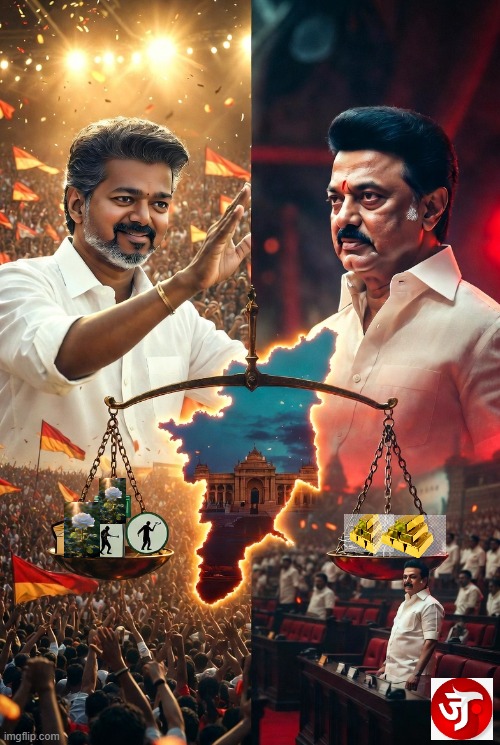
CM Vijay’s Dynamite Swearing-In: MK Stalin’s Cautionary Message – Rivals, Respect, or Something More in Tamil Nadu’s Political Theatre?
On May 10, 2026, Tamil Nadu witnessed a cinematic-style political spectacle. Actor-turned-leader Joseph Vijay, better known as Thalapathy Vijay, took the oath as Chief Minister, heading a coalition government after his Tamilaga Vettri Kazhagam (TVK) emerged as the single largest party with 108 seats in the 234-member Assembly. With support from Congress, left parties, VCK, and IUML, he crossed the majority mark.
The support of Congress, in itself, became a focal point of criticism, amid cheers, with many hitting out at the Grand Old Party betraying their time-tested ally, MK Stalin. Yet, as Congress explained, since Stalin did not have the numbers, and neither did Congress, thus yoking with Vijay would be the best way to keep the right-wing parties out, where at least their ideologies as left-wingers matched!
The swearing-in was electric, marked by massive crowds, fan frenzy, and Vijay’s trademark charisma. Yet, even as cheers echoed, thoughts turned to the man quietly watching from the opposition benches: former Chief Minister and DMK president M. Karunanidhi Stalin.
In his first major speech as CM, Vijay did not hold back. He accused the outgoing DMK government of “emptying the treasury” and leaving behind a staggering ₹10 lakh crore debt. The remark was vintage Vijay – bold, direct, and delivered with the punch of a film hero.
In a post on the social media platform X, Stalin responded: “Don’t start saying right away that the government has no money. It does have it. What’s needed is the will to give it to the people, and the ability to govern.” Stalin, reacting to Vijay wrote: “The debt level of Tamil Nadu is within the permitted limits.” The DMK president further said that his government has implemented countless welfare schemes over the past five years at a time the state was grappling with numerous hurdles such as the Covid-19 pandemic, floods, and neglect from the BJP-led central government.
Stalin said that his government had “clearly explained” the financial position of the Tamil Nadu government in the budget, presented in February. Addressing Vijay, he wrote: “Didn’t you know that? It was only after that you gave various promises to the people? Don’t deceive the people who voted for you again and try to divert the issue!”
The exchange set the tone for a new, high-stakes chapter in Tamil Nadu politics. To understand its depth, it is worth stepping back into the very different worlds that shaped these two leaders.
Backgrounds: Two Paths to Power
Joseph Vijay Chandrasekhar was born in 1974 into a film family. His father, S.A. Chandrasekhar, was a noted director; his mother, Shoba, a singer. The family’s interfaith roots (father Christian, mother Hindu) reflected a quiet pluralism that would later echo in his secular politics. Vijay began as a child artist, graduated to lead roles, and became one of Tamil cinema’s biggest superstars – “Thalapathy” – known for high-octane action, emotional depth, and a massive, almost devotional fan base. In 2024 he founded TVK, quit acting entirely, and threw himself into politics with the same single-minded intensity he once brought to the screen. His 2026 victory was nothing short of historic: an outsider disrupting the Dravidian duopoly with star power, youth appeal, and a welfare-heavy manifesto promising women’s assistance, youth unemployment aid, farmer support, and greater transparency.
Muthuvel Karunanidhi Stalin, born in 1953, comes from pure political royalty. He is the son of DMK patriarch M. Karunanidhi, the man who defined Dravidian politics for decades. Stalin was named after Soviet leader Joseph Stalin, a reflection of his father’s ideological leanings, and entered politics as a teenager. He was imprisoned during the 1975 Emergency, served as Chennai’s mayor, held key ministerial portfolios, became Deputy Chief Minister, and finally Chief Minister in 2021. His five-year term (2021-2026) was defined by large-scale welfare programmes delivered through a disciplined party machinery. Calm, organisational, and battle-hardened, Stalin earned the occasional nickname “Thalapathy Stalin” from admirers who saw in him the same steady command his father once wielded.
Similar Traits: Charisma, Mass Appeal, and a Shared Stage
Despite their contrasting journeys, Vijay and Stalin share striking commonalities that explain why both command such loyalty:
Mass connect: Both are performers at heart. Vijay’s magnetism was honed on screen; Stalin’s through decades of public oratory and grassroots organising. Their supporters treat them with near-filmi devotion.
Welfare-first politics: TVK’s manifesto mirrored many DMK promises, cash transfers to women, freebies, job schemes, and social justice rhetoric rooted in Dravidian ideology. Both leaders position themselves as champions of the common man.
Tamil identity and secularism: Whether through cinema or party ideology, both project Tamil pride, social equity, and resistance to what they see as central overreach.
Vijay’s Tougher Role: From celluloid charisma to the grind of governance
Joseph Vijay’s ascent to Chief Minister on May 10, 2026, is undeniably historic – a rare case of a superstar converting cinematic capital into political power in a single leap. Yet the very factors that propelled his victory now make his job significantly harder than the one MK Stalin just vacated. Where Stalin inherited a disciplined party machine and decades of institutional knowledge, Vijay steps into the role as an outsider heading a fragile coalition, armed primarily with star power and sky-high expectations.
His 108 seats – impressive, but 11 short of a simple majority in the 234-member Assembly. He rules through a patchwork alliance with Congress, Left parties, VCK, and IUML. Each partner has its own regional, ideological, and caste constituencies. Stalin, even when he operated with allies, always had the formidable DMK apparatus as the undisputed anchor. Vijay must now spend political capital keeping allies happy – allocating portfolios, honouring unwritten agreements, and preventing any one group from feeling short-changed. A single ally walking out could collapse the government. Stalin never faced that immediate existential pressure in his last term.
- Stalin is a battle-hardened Opposition that knows every trick who has seen
multiple challenges, survived the Emergency, and rebuilt the party after setbacks. Vijay’s mass appeal is real, but he would need to develop the deep cadre network, booth-level machinery, and institutional memory that Stalin commands. - In the Assembly, in the media, and on the streets, the DMK will probe every vulnerability – bureaucratic delays, coalition cracks, unfulfilled promises – with surgical precision. The “Thalapathy vs. Thalapathy Stalin” narrative that fans enjoy on screen now becomes an asymmetrical political war: one side with decades of experience, the other still proving it belongs.
- The transition from Thalapathy on screen to Thalapathy in the Secretariat will demand far more than charisma. It will test whether the outsider who disrupted Tamil Nadu’s political theatre can now master its backstage machinery. He asserted his stand strongly when he said in his first speech today: “There will only be one power centre, that is me.” The opening act is electric; the real drama is only beginning – Vijay the “chocolate-boy” star will endure…