
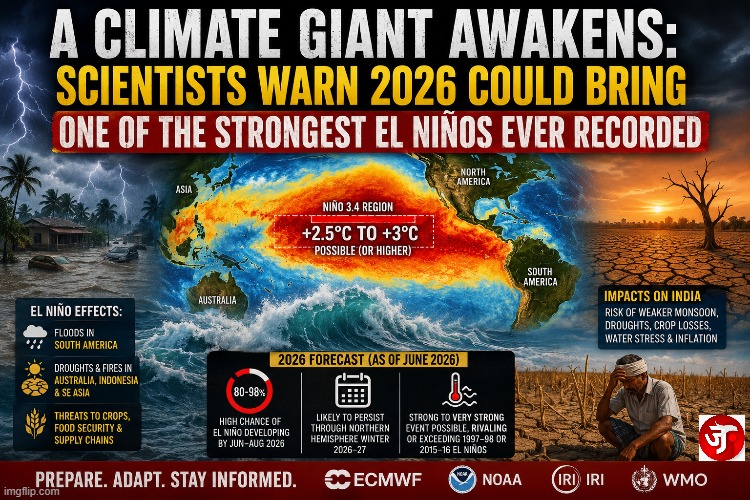
A powerful climate phenomenon is rapidly taking shape across the Pacific Ocean, and scientists around the world are watching closely.
According to the fresh weather predictions published by ECMWF (European Centre for Medium-Range Weather Forecasts) in June 2026, a dangerous “Super El Niño” is in the works off the Pacific Coastline. The experts are afraid that this weather anomaly might turn out to be the most powerful and most dangerous event of this kind since the dawn of the modern satellite era.
Other major international agencies including NOAA, the International Research Institute (IRI), and the World Meteorological Organization (WMO), confirm that there is now a strong likelihood that a major El Niño event will develop in 2026, potentially ranking among the strongest ever observed.
Current forecasts indicate an 80–98% probability that El Niño conditions will emerge during the coming months and persist through the Northern Hemisphere winter of 2026–27. Some climate model projections suggest sea surface temperature anomalies in the critical Niño 3.4 region could exceed +2.5°C and potentially climb above +3°C, levels associated with the most intense El Niño events in modern history.
While some media reports have described the developing phenomenon as a “climate bomb” or “super El Niño,” scientists caution that such language can be misleading. “Super El Niño” is not an official scientific classification but rather a media term commonly used to describe exceptionally strong events, generally those exceeding +2.0°C in the Nino 3.4 region.
Under normal conditions, strong easterly trade winds push warm surface waters westward toward Indonesia and Australia, allowing colder, nutrient-rich water to rise along the coast of South America.
During El Niño, those trade winds weaken or sometimes reverse. Warm water spreads eastward across the Pacific Ocean, causing significant warming of the ocean surface. This shift alters global atmospheric circulation patterns, including the Walker Circulation, triggering weather disruptions around the world.
The opposite phase of this climate cycle is known as La Nina, characterized by cooler waters in the eastern Pacific and stronger trade winds.
This could be the worst!
Recent ECMWF model runs have steadily increased the projected intensity of the developing event. Some ensemble forecasts now suggest temperature anomalies that could rival, or in some scenarios exceed, the legendary 1997–98 and 2015–16 El Nino episodes, both of which triggered widespread global weather extremes.
However, experts stress that significant uncertainty remains. Not every model predicts record-breaking temperatures, and the eventual strength of the event will depend on how effectively the atmosphere couples with the warming ocean. While record territory is possible, it is far from guaranteed.
For India, the Stakes are Particularly High!
El Nino’s Impact on India in 2026: Detailed Outlook: A developing El Nino (potentially strong or “super”) in 2026 is expected to suppress India’s southwest monsoon, leading to below-normal rainfall, higher temperatures, and cascading effects on agriculture, water resources, food prices, and the economy. The monsoon provides ~70% of India’s annual rainfall and is critical for 50-60% rainfed agriculture.
Monsoon Rainfall (June–September 2026)
- IMD Forecast: 92% of Long Period Average (LPA), classified as below normal. There’s a 35% chance of a deficient season (90% LPA), higher than the historical average of 6%.
- Timing of Impact: El Nino often weakens rains especially in the second half of the season (August–September), which is critical for crop growth.
- Spatial Effects: Central and northwest India (core monsoon zone) are most vulnerable to deficits. Northeast and some southern areas may see relatively better or uneven rainfall.
- Historical Context: In strong El Nino years (e.g., 2009: -22%, 2015: -14%), droughts occurred. However, 1997 (very strong El Niño) had near-normal rains due to a positive Indian Ocean Dipole (IOD) offsetting the effect. A positive IOD in 2026 could partially mitigate but not fully neutralize the impact.
2. Agriculture and Food Security
- Kharif Crops (sown June–Aug, harvested Oct-Dec): Rice, maize, cotton, soybeans, sugarcane, and pulses are highly vulnerable. Reduced rainfall + delayed onset – lower sowing area and yields. Over 50% of farmland is rainfed.
- Rabi Crops (winter): Lower soil moisture from a weak monsoon can affect wheat and other crops planted later.
- Overall Risks: Smaller harvests – supply shortages. Food inflation could rise (historically 2-4% higher in deficit years). Livestock and fisheries may also face water stress.
- Regional Hotspots: Major producing states like Uttar Pradesh, Maharashtra, Rajasthan, and Madhya Pradesh could see the biggest hits.
3. Water Resources and Drought
- Reservoirs (especially in the north) are already at low levels in some forecasts. A deficit monsoon would worsen water shortages for irrigation, drinking, and hydropower.
- Increased groundwater extraction (higher energy demand for pumps).
- Higher risk of drought in rain-dependent areas, potentially leading to rural distress and migration.
4. Economy and Broader Impacts
- GDP Growth: Agriculture contributes ~18% to GDP but supports livelihoods for nearly half the population. A weak monsoon can shave 0.2-0.6% off overall growth (more in severe cases). Some estimates suggest potential long-term losses in the trillions of rupees due to compounded effects.
- Inflation: Food prices (especially staples and vegetables) rise, affecting rural incomes and overall CPI.
- Rural Economy: Lower farmer incomes – reduced consumption of goods, impacting manufacturing and services.
- Heatwaves: El Niño often amplifies summer heat (already intense in 2026). More extreme temperatures, prolonged heatwaves, and possible forest fires.
- Positive Offsets: Stronger non-farm rural jobs, government schemes (MSP, cash transfers, irrigation expansion), and better buffer stocks may make the economy more resilient than in past decades. business-standard.com
5. Other Weather Effects
- Uneven Distribution: Some areas may see flash floods or heavy bursts despite overall deficit.
- Winter (2026–27): Milder winters in north India possible; impacts on post-monsoon rains (northeast monsoon) vary.
- Global Context: Combined with background warming, any El Nino makes India hotter overall.
Uncertainties and Mitigating Factors
- Strength of El Niño: Stronger event – higher risk, but exact peak (late 2026) matters.
- Indian Ocean Dipole (IOD): A positive IOD could bring extra moisture and partially rescue the monsoon.
- Not Guaranteed Disaster: Not every El Niño causes severe drought (e.g., 1997 exception). Models have uncertainty.
Preparation Recommendations (from experts):
- Promote drought-resistant crops (millets, certain pulses).
- Efficient irrigation, rainwater harvesting, and crop diversification.
- Government buffers: Higher MSP, subsidies for seeds/insurance.
- Monitor IMD/Skymet updates closely.
- Global Ripple Effects!
The consequences of a major El Niño extend far beyond South Asia.
Typical El Nino patterns include:
- Increased flooding risks in parts of South America.
- Drought and heightened wildfire danger across Australia, Indonesia, and Southeast Asia.
- Disruptions to fisheries due to reduced nutrient-rich upwelling in the eastern Pacific.
- Potential impacts on global food production and supply chains.
- Increased likelihood of extreme weather events in various regions.
Adding to concerns is the role of long-term global warming. Scientists note that today’s warmer climate means any strong El Niño is likely to push global temperatures even higher, increasing the risk of heatwaves and climate-related extremes.
While forecasts are increasingly pointing toward a powerful El Niño, climate experts emphasize that predictions are not certainties. The event is still developing, and its ultimate strength will become clearer over the coming months.
The science supports vigilance and preparation and not panic.
What is becoming increasingly clear is that the Pacific Ocean may once again be preparing to reshape weather patterns across the planet. If current forecasts hold, late 2026 and early 2027 could become one of the most closely watched climate periods in decades, with implications for agriculture, water resources, economies, and communities worldwide.
For now, scientists recommend keeping a close eye on updates from ECMWF, NOAA, IRI, and the WMO as the world’s largest climate engine begins to stir.