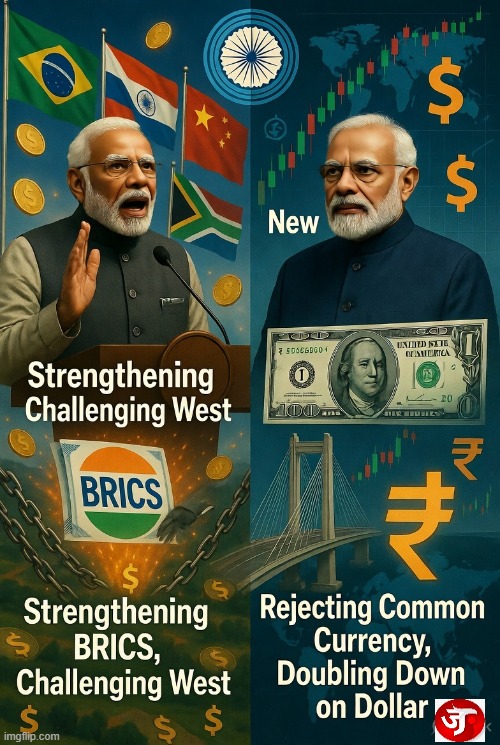

Narendra Modi has long championed a stronger BRICS as a platform for the Global South, greater multipolarity, and reformed global governance. In earlier summits, he spoke of enhancing economic cooperation among Brazil, Russia, India, China, and South Africa to amplify emerging economies’ voices and reduce over-reliance on any single system. Yet, India has consistently rejected proposals for a common BRICS currency or aggressive de-dollarization, a stance that remains firm in 2026 as India holds the BRICS presidency.
Early Vision vs. Current Stance
At BRICS forums, Modi has emphasized “reform, not replacement” of institutions like the UN Security Council and Bretton Woods system. He advocated for the New Development Bank and greater use of national currencies in bilateral trade to lower transaction costs and hedge risks, practical steps, not ideological warfare against the West.
India continues to push local-currency settlements (notably with Russia for oil) and even proposes linking BRICS central bank digital currencies (CBDCs) for smoother payments. However, External Affairs Minister S. Jaishankar, RBI Governor, and Commerce Minister have repeatedly clarified: de-dollarization is not India’s objective, and a shared BRICS currency is “impossible” due to divergent economies, lack of trust, and China’s dominance.
What Changed – Or Didn’t?
Little has fundamentally shifted in India’s position; the rhetoric around “challenging Western dominance” was often overstated by observers. Key factors explain the clarity today:
Economic Pragmatism: The US dollar remains the bedrock of global trade, reserves, and stability. India’s massive imports (energy, electronics, defense), exports, and foreign investment flows benefit from dollar liquidity. Disrupting this invites volatility and higher costs.
Strategic Autonomy: India values strong ties with the US, Quad, and Europe for technology, defense (e.g., Boeing deals), and countering China. A currency war risks Trump-era tariffs or sanctions, which New Delhi has explicitly sought to avoid.
BRICS Realities: Deep internal differences – India-China border tensions, Russia’s isolation, Brazil’s shifting priorities – make a viable common currency unfeasible. Modi has warned against BRICS becoming an “anti-West” bloc, stressing cooperation for humanity’s benefit instead.
Risk Management: A China-led alternative raises concerns over capital controls, convertibility, and geopolitical weaponization.
The Way Forward
Under India’s 2026 presidency, BRICS focuses on trade in national currencies, payment system interoperability, digital innovation, and Global South priorities — evolutionary reforms, not revolution. Modi’s approach reflects India’s classic foreign policy: multi-alignment over bloc politics. Strengthen partnerships everywhere, but avoid choices that harm core economic interests.
In a volatile world, pragmatic realism – leveraging BRICS for diversification while anchoring in dollar stability serves India’s rise better than symbolic challenges. The dollar’s dominance endures not just by Western power, but by global trust and utility. India appears content to navigate that reality.